
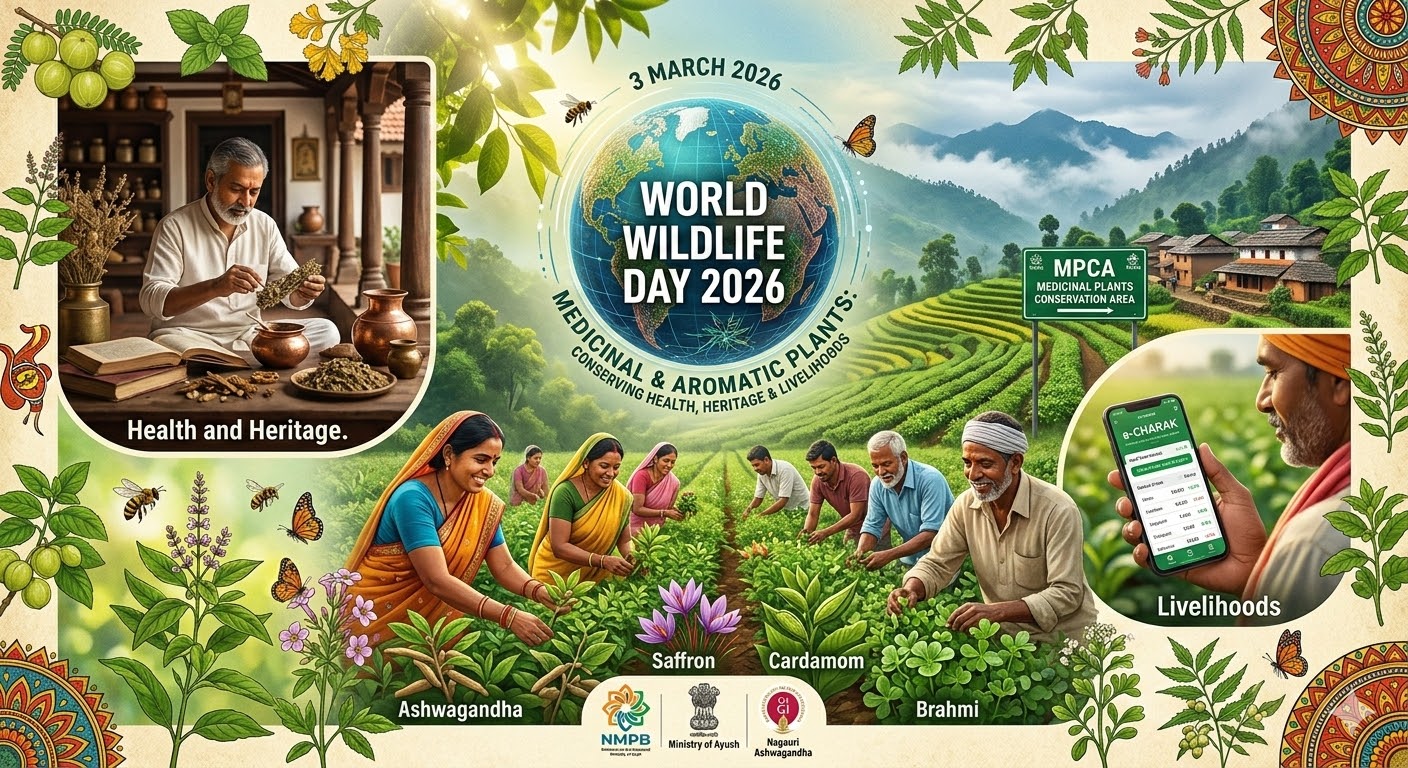
Quick Bite World Wildlife Day 2026
India is observing World Wildlife Day 2026 with the theme “Medicinal and Aromatic Plants: Conserving Health, Heritage and Livelihoods”, highlighting the vital role of medicinal plants in healthcare, biodiversity conservation and rural livelihoods. India hosts about 45,000 plant species, including nearly 15,000 medicinal plants, while government schemes and digital platforms like the National Medicinal Plants Board initiatives and the e-CHARAK app are supporting conservation, cultivation, value addition and marketing of medicinal and aromatic plants across the country.
World Wildlife Day is observed globally every year on 3 March to mark the adoption of the Convention on International Trade in Endangered Species of Wild Fauna and Flora (CITES). This UN-proclaimed day highlights the vital role of wild fauna and flora in sustaining life, livelihoods, and healthy ecosystems.
For 2026, the theme is “Medicinal and Aromatic Plants: Conserving Health, Heritage and Livelihoods”, underlining how plant resources support public health, preserve traditional knowledge, and create livelihood opportunities for millions, especially in developing countries.
🌿 Theme 2026: Medicinal and Aromatic Plants
Medicinal and aromatic plants form the backbone of traditional medicine systems and contribute significantly to modern pharmaceuticals. Across developing countries, an estimated 70–95% of people rely on traditional medicine for primary healthcare, much of it derived from plant-based resources. These plants also support pollinators, improve soil health, and enhance overall biodiversity, making their conservation a global priority.
In India, the 2026 theme is particularly relevant, as medicinal and aromatic plants are central to Ayurveda, Siddha, Unani, folk medicine, and local healing traditions. Their sustainable use links environmental protection with cultural heritage and income generation for rural and forest-dependent communities.
🌿 India’s Rich Heritage of Medicinal Plants
India is recognised as one of the 17 mega biodiversity-rich countries of the world and hosts nearly 7% of global biodiversity. The country has about 45,000 plant species, of which nearly 15,000 are medicinal plants; around 8,000 of these are used in Indian systems of medicine and folk remedies.
Nearly 70% of India’s medicinal and aromatic plants are found in the tropical forests of the Western and Eastern Ghats, the Himalayas, and the Aravalli range. The Botanical Survey of India has identified over 5,250 plant species and documented more than 9,567 folk claims for various ailments, reflecting the depth of traditional knowledge associated with these resources.
As per the study “Medicinal Plants in India: An Assessment of their Demand and Supply” (Ved & Goraya, 2017), India’s annual domestic demand for medicinal plants was about 5,12,000 metric tonnes in 2014–15. The study recorded 1,178 medicinal plant species in trade, with 242 species traded in high volumes (above 100 metric tonnes per annum), demonstrating the sector’s economic significance.
🌿 Conservation: In-situ and Ex-situ Efforts
India follows a multi-layered strategy to conserve medicinal and aromatic plants through both in-situ and ex-situ approaches.
In-situ conservation is the most effective way to preserve biodiversity because it allows plants to continue evolving within their natural ecosystems alongside their pollinators and local communities.
🛡️ The In-Situ Conservation Framework
India’s strategy for protecting medicinal plants in the wild is built on a network of protected areas, with a specialized focus on Medicinal Plants Conservation Areas (MPCAs).
| Component | Function |
| National Parks & Sanctuaries | Large-scale protection of entire ecosystems, including the flora within them. |
| Biosphere Reserves | Large areas of terrestrial or coastal ecosystems where conservation is balanced with sustainable use. |
| MPCAs | 115 sites specifically designated to safeguard medicinal species and traditional healing knowledge. |
🌿 The Significance of MPCAs
Unlike general forest reserves, MPCAs are unique because they serve as “Gene Sanctuaries.” * Natural Evolution: Plants are allowed to adapt to changing climate conditions and pests in real-time, which is something a seed bank cannot replicate.
- Cultural Integration: These sites often integrate indigenous health traditions. They are not just biological sites; they are repositories of the cultural history and “folk claims” associated with local medicine.
- Biodiversity Anchors: By protecting the primary habitat of these plants, MPCAs also protect the insects, birds, and soil microbes that rely on them.
💡 Why In-Situ is Vital for 2026
Under the current theme of “Health, Heritage, and Livelihoods,” in-situ conservation ensures that the “Heritage” aspect remains alive. It provides a living laboratory for researchers and a source of sustainable, wild-harvested material for local communities, provided it is managed under strict Good Agricultural and Collection Practices (GACPs).
🌿 India’s Ex-Situ Conservation of Medicinal Plants
While in-situ conservation protects plants in their natural homes (like National Parks), ex-situ conservation acts as a “biological insurance policy” by securing genetic resources in controlled environments. This is vital for species that are endangered or have difficulty reproducing in the wild.
🧬 The National Seed Gene Bank (NBPGR)
The primary hub for this effort is the National Bureau of Plant Genetic Resources (NBPGR) in New Delhi.
- Capacity: It houses approximately 9,361 accessions of medicinal and aromatic plants.
- Method: Long-term preservation, typically through cold storage of seeds.
- Purpose: Ensuring a backup of genetic diversity that can be used for research, breeding, or reintroduction into the wild if a species becomes extinct in its habitat.
🛠️ Other Ex-Situ Methods Used in India
Beyond the National Seed Gene Bank, India employs several other technical “off-site” methods:
| Method | Description |
| Cryopreservation | Storing plant tissues or seeds at ultra-low temperatures (using liquid nitrogen) to stop all biological activity for decades. |
| In-Vitro Conservation | Growing plant cells or tissues in a sterile nutrient medium (test tubes) to propagate species that don’t produce seeds easily. |
| Herbal Gardens | Established in schools and public institutions to maintain “living collections” while educating the public. |
| Field Gene Banks | Growing collections of living plants in a specific location to maintain species that cannot be stored as seeds. |
💡 Why Ex-Situ Matters for 2026
Under the 2026 World Wildlife Day theme, “Medicinal and Aromatic Plants: Conserving Health, Heritage and Livelihoods,” these gene banks are more than just storage; they are the foundation for:
- Sustainable Cultivation: Providing high-quality starting material for farmers via the MIDH and NAM schemes.
- Climate Resilience: Preserving varieties that might be naturally resistant to emerging pests or changing weather patterns.
- Digital Integration: Linking physical samples to platforms like e-CHARAK to ensure the industry uses verified, high-quality botanical sources.
The National Medicinal Plants Board (NMPB) under the Ministry of Ayush anchors many of these efforts through a dedicated scheme for conservation, development, and sustainable management of medicinal plants. This includes awareness campaigns, farmer training, research, and marketing support.
Key Government Schemes and Initiatives
🌿 National Ayush Mission (NAM) and MIDH
The Ministry of Ayush earlier implemented a Medicinal Plant Component under the National Ayush Mission (NAM) through States and Union Territories from 2015–16 to 2020–21. This scheme promoted cultivation of medicinal plants integrated with farming systems, supporting crop diversification and enhancing farmer incomes.
At present, the Ministry of Agriculture and Farmers Welfare supports medicinal plants under the Mission for Integrated Development of Horticulture (MIDH), a centrally sponsored scheme aimed at holistic growth of the horticulture sector. All States and Union Territories are covered under MIDH.
🌿 Aushadhi Vanaspati Mitra Program (AVMP)
The Aushadhi Vanaspati Mitra Program (AVMP) of NMPB, Ministry of Ayush, recognises and rewards individuals, communities, and institutions for outstanding contributions to medicinal plant conservation, cultivation, and marketing. By honouring such efforts, AVMP encourages wider public participation in protecting medicinal plant resources.
🌿 Central Sector Scheme on Medicinal Plants
The Government of India, through NMPB, implements the Central Sector Scheme on “Conservation, Development and Sustainable Management of Medicinal Plants” with a financial outlay of ₹322.41 crore for 2021–22 to 2025–26. Under this scheme, Medicinal Plants Conservation and Development Areas (MPCDAs) are created to protect species in their natural habitats, and plantations are supported on degraded and rural lands.
The scheme also promotes research and quality assurance through Good Agricultural and Collection Practices (GACPs) and a network of Raw Drug Repositories across the country. These interventions strengthen the entire value chain from cultivation to quality raw material supply.
🌿 e-CHARAK: Digital Marketplace for Medicinal Plants
To facilitate better market access and information exchange, NMPB has launched the “e-CHARAK” mobile application and web portal. This platform connects farmers and other stakeholders in the medicinal plant sector and provides regularly updated fortnightly market prices of 100 medicinal plants from 25 herbal markets across India.
The e-CHARAK application is available in multiple local languages, making digital tools more accessible to farmers and rural communities. By improving transparency and market linkages, it helps farmers realise better value for their produce.
🌿 Herbal Gardens and Awareness
Herbal gardens are being promoted in schools, institutions, and public spaces to build awareness about medicinal plants among students and the general public. Species-specific campaigns through electronic and print media highlight the role of these plants in daily life and healthcare.
Such initiatives familiarise young learners with local flora and traditional knowledge, reinforcing the link between biodiversity conservation and human well-being.
🌿 Livelihoods, Communities, and International Cooperation
The Central Sector Scheme also extends financial and infrastructural support to Joint Forest Management Committees, Self Help Groups, Van Panchayats, and Biodiversity Management Committees. This support covers value addition, drying, warehousing, and marketing of medicinal plants, directly improving the livelihoods of local and forest-dependent communities.
At the international level, NMPB collaborates with various organisations to promote India’s medicinal plant sector globally. It participates in international exhibitions and works to safeguard India’s traditional knowledge while ensuring fair and equitable benefit-sharing under global agreements.
🌿 Integrated Component and Medicinal Plants Business Centre
Under the Central Sector Scheme, NMPB is implementing the “Forward and backward linkage in supply chain of medicinal plants (Integrated Component)” across the country. Key activities supported under this component include:
- Infrastructure for quality planting material to support cultivation.
- Information, Education and Communication (IEC) activities to create awareness among farmers.
- Infrastructure for post-harvest management and marketing, aimed at increasing marketability, adding value, improving profitability, and reducing losses.
- Quality testing and certification of raw material.
A new component, the “Medicinal Plants Business Centre (MPBC),” has been incorporated to strengthen post-harvest and marketing infrastructure. Its objectives include:
- Developing dedicated business centres to manage medicinal plant produce effectively.
- Promoting innovative and modern technologies in post-harvest management and marketing.
- Creating scientific storage capacity to reduce post-harvest and handling losses.
- Providing facilities for washing, sorting, grading, value addition, packaging, storage, and quality testing of raw material.
🌿 Protecting India’s Medicinal Plant Heritage through GI Tags
Geographical Indication (GI) tags play a crucial role in protecting region-specific medicinal and aromatic plant products and associated traditional knowledge. Several important medicinal resources from India already enjoy GI status:
- Navara Rice (Oryza sativa L.):
Cultivated mainly in Palakkad and nearby districts of Kerala, Navara rice is known as Shashtikashali in Ayurveda. It is a key component of the Panchakarma treatment Navarakizhi and is used for managing rheumatic pain, polio-related disabilities, blood circulation problems, and certain respiratory diseases. - Green Cardamom (Elettaria cardamomum (L.) Maton):
Two GI-recognised varieties are Alleppey Green Cardamom from Kerala and Coorg Green Cardamom from Karnataka. Referred to as Sukshma-ela or Elaichi in Ayurveda, it is used in treatments for asthma, cough, and difficulties in urination. - Ganjam Kewda Flower (Pandanus odorifer (Forssk.) Kuntze):
GI tagged for Odisha, especially Ganjam district, this flower is known as Ketakipushpa in Ayurveda. It is used in managing eye problems and respiratory disorders. - Saffron (Crocus sativus L.):
GI tagged for Jammu and Kashmir, saffron is called Kumkuma in Ayurveda. It is used for treating migraine, aiding wound healing, controlling vomiting, and managing skin discoloration and patches. - Nagauri Ashwagandha (Withania somnifera):
“Nagauri Ashwagandha” has recently been registered as a GI product under an NMPB-supported project (GI Application No. 1143, dated 24 November 2025). This recognition supports the unique identity and quality of Ashwagandha associated with the Nagaur region.
🏷️ The Power of Protection: GI Tags
Geographical Indication (GI) tags protect the unique identity and traditional knowledge associated with specific regions.
| Product | Region | Ayurvedic Use |
| Nagauri Ashwagandha | Rajasthan | Vitality and stress relief (Newly Added!) |
| Kashmir Saffron | J&K | Skin health, migraines, and healing. |
| Navara Rice | Kerala | Rheumatic pain and blood circulation. |
| Ganjam Kewda Flower | Odisha | Respiratory and eye health. |
| Green Cardamom | Kerala/Karnataka | Asthma and digestive issues. |
🌿 FAQs on World Wildlife Day 2026 and Medicinal Plants
Q1. What is the theme of World Wildlife Day 2026?
The theme of World Wildlife Day 2026 is “Medicinal and Aromatic Plants: Conserving Health, Heritage and Livelihoods”.
Q2. Why are medicinal and aromatic plants important?
Medicinal and aromatic plants are vital for traditional medicine, modern healthcare, biodiversity conservation and livelihood generation for rural and forest-dependent communities.
Q3. How rich is India in medicinal plant diversity?
India has about 45,000 plant species, of which nearly 15,000 are medicinal plants, and around 8,000 are used in Indian systems of medicine and folk remedies.
Q4. What is the role of the National Medicinal Plants Board (NMPB)?
The National Medicinal Plants Board implements schemes for conservation, cultivation, sustainable management and marketing of medicinal and aromatic plants across India.
Q5. Which government schemes support medicinal plant cultivation in India?
Medicinal plants are supported through the Central Sector Scheme on Medicinal Plants and the Mission for Integrated Development of Horticulture (MIDH).
Q6. What is e-CHARAK and how does it help farmers?
e-CHARAK is a mobile app and web portal that provides market linkages and fortnightly price information for 100 medicinal plants from 25 herbal markets in India.
Q7. What are Medicinal Plants Conservation Areas (MPCAs)?
MPCAs are designated forest areas created to conserve medicinal plant species in their natural habitats; currently 115 such sites exist in India.
Q8. How does India conserve medicinal plants ex-situ?
About 9,361 accessions of medicinal and aromatic plants are conserved at the National Seed Gene Bank of NBPGR, New Delhi, for long-term preservation.
Q9. Which medicinal plant products from India have GI tags?
Products like Navara rice, green cardamom (Alleppey and Coorg), Ganjam kewda flower, Kashmir saffron and Nagauri Ashwagandha have Geographical Indication tags.
Q10. How do herbal gardens promote awareness about medicinal plants?
Herbal gardens in schools and public institutions help students and citizens learn about local medicinal plants, traditional knowledge and the importance of conservation.
Conclusion
India’s efforts to protect medicinal and aromatic plants reflect a vision that combines conservation, healthcare, cultural heritage, and livelihood security. From in-situ conservation sites to national gene banks, from farmer-centric schemes to digital platforms like e-CHARAK, and from school herbal gardens to GI-tagged products, the country is building a robust ecosystem around its medicinal plant wealth.
As the world marks World Wildlife Day 2026, India’s initiatives demonstrate how biodiversity conservation can support public health, empower local communities, and contribute to sustainable development for generations to come.
Source: Press Information Bureau (PIB), Government of India
[…] it remains our sacred duty to protect the fragile equilibrium of our forests, particularly the rare medicinal and aromatic plants that represent India’s ancient healing […]
[…] and enforcement, you can round off your Biodiversity notes by reading our previous deep dive on the Conservation of Medicinal and Aromatic Plants (MAPs)—a crucial component of India’s floral […]