
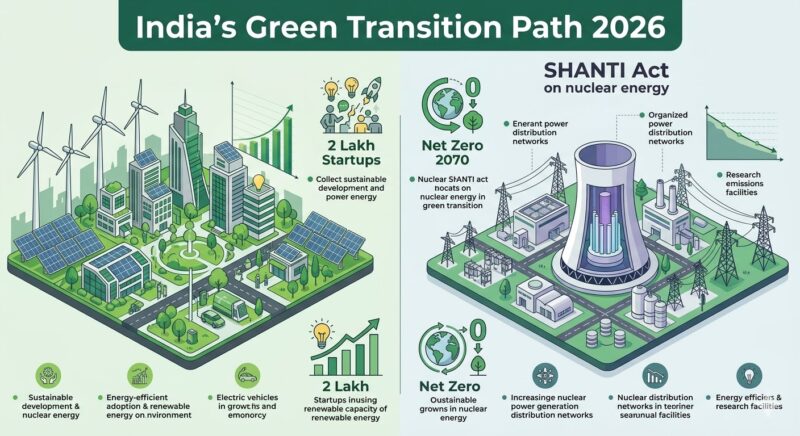
The most critical data point from the latest government address is the revelation that India now hosts over 2 lakh startups, with nearly 50% emerging from Tier-II and Tier-III cities, marking a massive decentralized shift in India’s innovation-led green economy.
Data Table: India’s Innovation & Sustainability Landscape (2024 vs. 2026)
| Metric | Status (Approx. 2024) | Current Status (March 2026) | Trend/Impact |
| Total Startups | ~1.2 Lakh | 2 Lakh+ | Exponential Growth |
| Tier-II/III Participation | ~40% | ~50% | Decentralized Innovation |
| Nuclear Policy | Government Restricted | SHANTI Act (Private Entry) | Landmark Reform |
| Net Zero Target | 2070 | 2070 (On Track) | Policy Consistency |
| Green Infrastructure | Nascent/Developing | Central Pillar of Growth | Strategic Priority |
Technical Section: Understanding the SHANTI Act vs. Traditional Nuclear Policy
For UPSC and JPSC aspirants, understanding the legislative shift in the energy sector is crucial.
- The SHANTI Act (Sustainable Harnessing and Accelerating Nuclear Transformation of India): Unlike the previous restrictive frameworks under the Atomic Energy Act of 1962, the SHANTI Act is a landmark reform that allows private sector participation in nuclear energy.
- Base Year & Transition: While traditional energy metrics were often compared against the 2011-12 base years for industrial indices, the current focus shifts toward Carbon Intensity and Renewable Integration capacity.
- Core Difference: Traditional nuclear policy focused solely on strategic autonomy and state control. The new SHANTI Act focuses on Nuclear for Net Zero, treating nuclear as a “clean and dependable” energy source essential for 24/7 power required by AI data centers.
“Quick Bite” for Aspirants
- SHANTI Act: Opens nuclear energy to private players for the first time.
- Startup Growth: India crossed the 2-lakh startup milestone in March 2026.
- LiFE Movement: Lifestyle for Environment remains the grassroots driver for sustainability.
- Net Zero: India’s commitment remains fixed at 2070, with green hydrogen and nuclear as twin pillars.
- Circular Economy: Transitioning from “Waste” to “Wealth” via innovative recycling technologies.
Source: For the official press release, refer to the Ministry of Science & Technology via PIB Release ID: 2241389.
Frequently Asked Questions (FAQs)
Q1: What is SHANTI Act mentioned in the 2026 PIB release?
The SHANTI Act (Sustainable Harnessing and Accelerating Nuclear Transformation of India) is a reformative law that allows private sector participation in India’s nuclear energy sector to accelerate the transition to clean energy.
Q2: How many startups does India currently have as of March 2026?
According to Union Minister Dr. Jitendra Singh, India has surpassed 2 lakh startups, with nearly half of them operating out of Tier-II and Tier-III cities.
Q3: What is India’s target year for achieving Net Zero emissions?
India remains committed to achieving Net Zero carbon emissions by the year 2070, as reaffirmed in the 10th Sustainable Business Futures Summit.
Q4: Why is the nuclear sector being opened to private players?
The opening of the nuclear sector is intended to provide a reliable, round-the-clock (24/7) clean energy supply specifically for high-demand sectors like Data Centers and Artificial Intelligence (AI).
Comments are closed.