
Ministry: Rural Development | Date: 17 March 2026 | Source: PIB Delhi (Release ID: 2241357)
Introduction
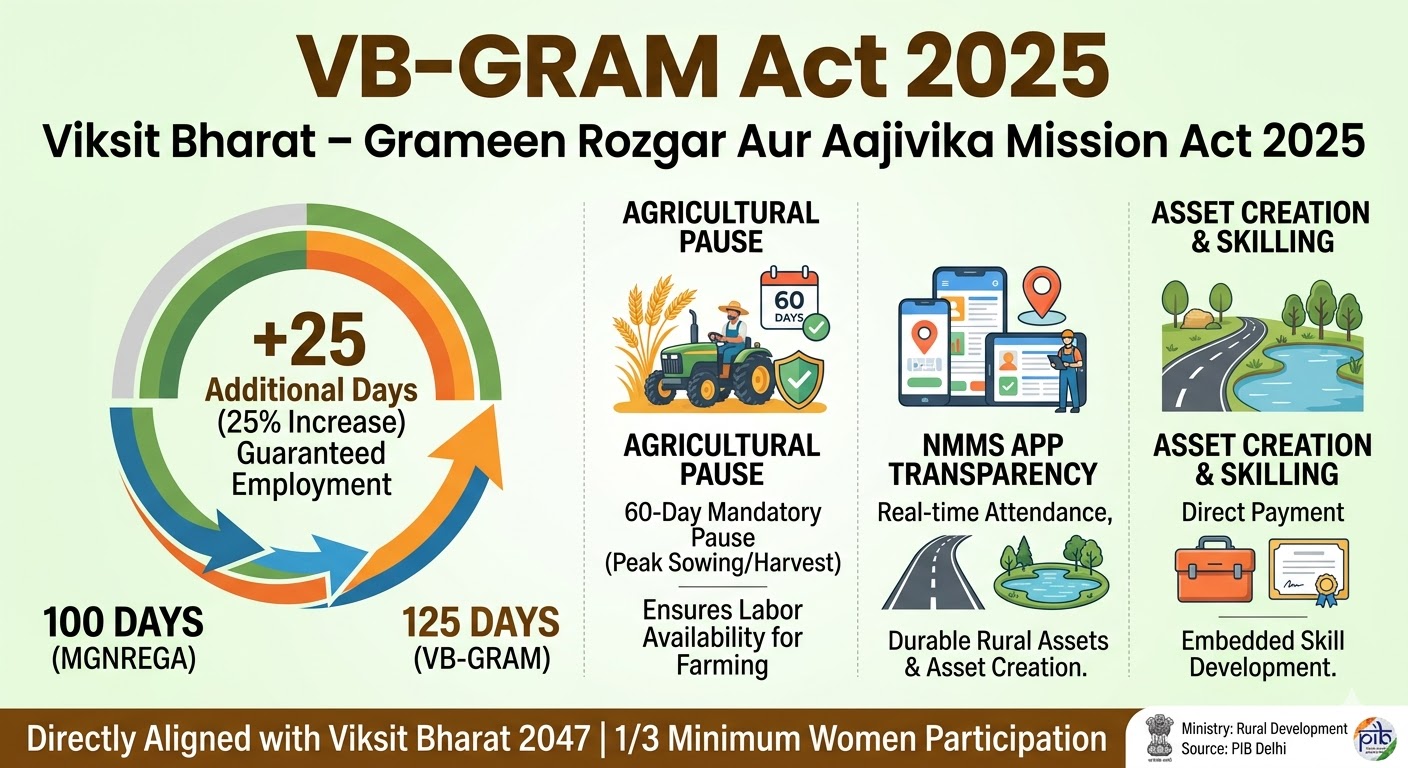
The VB-GRAM Act 2025 (Viksit Bharat – Grameen Rozgar Aur Aajivika Mission Act 2025) is a landmark legislation that guarantees 125 days of rural employment per household per year, upgrading and expanding the framework of the existing Mahatma Gandhi NREGS (MGNREGS). Announced on 17 March 2026 by the Ministry of Rural Development, this Act is directly aligned with the Viksit Bharat 2047 vision and is critical for UPSC Mains GS-II, GS-III, and JPSC aspirants.
Key Facts at a Glance
| Act Name | VB-GRAM Act 2025 |
| Full Form | Viksit Bharat – Grameen Rozgar Aur Aajivika Mission Act |
| Ministry | Ministry of Rural Development |
| Employment Guarantee | 125 days per rural household per year |
| MGNREGS Days (Earlier) | 100 days per household |
| Increase | +25 additional days (25% increase) |
| Vision Link | Viksit Bharat 2047 |
| Announced | 17 March 2026 |
What is VB-GRAM Act 2025?
The VB-GRAM Act 2025 builds upon the existing Mahatma Gandhi National Rural Employment Guarantee Act (MGNREGA) framework, extending guaranteed wage employment from 100 days to 125 days per rural household annually. It also introduces enhanced livelihood components, skill development linkages, and convergence with other rural welfare schemes.
Key Features of VB-GRAM Act 2025
- 125 Days Guarantee: Legal guarantee of 125 days of wage employment per rural household per financial year.
- Enhanced Wages: Wages linked to inflation-indexed rates to ensure real income growth.
- Livelihood Mission Link: Convergence with DAY-NRLM (Deendayal Antyodaya Yojana – National Rural Livelihoods Mission).
- Skill Development: Mandatory skilling component embedded within the employment guarantee framework.
- Digital Transparency: NMMS App integration for attendance, muster rolls, and payment tracking.
- Women Participation: Minimum 1/3rd reservation for women in all works.
- Asset Creation Focus: Emphasis on durable rural assets — roads, water bodies, plantations.
- Viksit Bharat Alignment: Directly feeds into the goal of a prosperous, self-reliant rural India by 2047.
The “Agricultural Pause” Clause (New)
To resolve long-standing labor shortages in farming, the Act introduces a statutory 60-day pause.
- Mechanism: State governments notify a 60-day period (split or continuous) during peak sowing and harvesting seasons.
- Impact: Public works are suspended to ensure labor availability for agriculture, while the 125-day guarantee is fulfilled during the remaining 305 days of the year.
VB-GRAM vs MGNREGA: Key Differences
| Parameter | MGNREGA (2005) | VB-GRAM Act (2025) |
| Work Guarantee | 100 Days | 125 Days |
| Funding Model | Demand-Driven (Open Budget) | Normative Allocation (Budget-Capped) |
| Wage Funding | 100% by Centre | 60:40 Sharing (Centre:State) |
| Agri-Symmetry | Year-round work | 60-Day Mandatory Pause |
| Planning | Gram Panchayat Level | Viksit Gram Panchayat Plans (VGPP) |
| Infrastructure | Asset creation (Local) | National Rural Infrastructure Stack |
NMMS App – Transparency Tool
The National Mobile Monitoring System (NMMS) App plays a crucial role under VB-GRAM by ensuring real-time attendance capture, geo-tagged muster rolls, and direct payment to worker accounts — eliminating middlemen and reducing leakages in rural employment payments.
NSAP – Social Security Convergence
The National Social Assistance Programme (NSAP) complements VB-GRAM by providing a social security net to rural poor — covering old age, widow, disability, and family benefit schemes. The 2026-27 Budget saw a record allocation to NSAP alongside VB-GRAM, forming a comprehensive rural welfare architecture.
Quick Revision Box
- Act: VB-GRAM Act 2025
- Days Guaranteed: 125 days/year (up from 100 under MGNREGA)
- Ministry: Rural Development
- Key tools: NMMS App for transparency
- Convergence: DAY-NRLM, NSAP
- Vision: Viksit Bharat 2047
- Women: Minimum 1/3 participation
FAQ Section:
Q1: What is the full form of the VB-GRAM Act 2025? Answer: It stands for the Viksit Bharat – Guarantee for Rozgar and Ajeevika Mission (Gramin) Act, 2025.
Q2: How many days of work are guaranteed under the VB-GRAM Act? Answer: The Act legally guarantees 125 days of wage employment per rural household in a financial year, an increase from the 100 days previously offered under MGNREGA.
Q3: What is the “60-day Agricultural Pause” in the VB-GRAM Act? Answer: To prevent labor shortages during peak farming seasons, the Act allows State governments to pause public works for up to 60 days during sowing and harvesting periods, ensuring that agricultural productivity is not hampered.
Q4: What is the funding pattern for the VB-GRAM Act 2025? Answer: The funding is shared between the Centre and States in a 60:40 ratio for most states, and a 90:10 ratio for North-Eastern and Himalayan States.
Q5: How does the NMMS App help in the VB-GRAM Act? Answer: The National Mobile Monitoring System (NMMS) App is used for real-time, geo-tagged attendance of workers and digital tracking of muster rolls to ensure transparency and prevent financial leakages.
Source: PIB Delhi, 17 March 2026 | Release ID: 2241357
Also Read: Related UPSC Notes on Rural Development & Welfare
- Jal Jeevan Mission 2.0: Rajasthan & MP MoUs – UPSC 2026
- e-NAM, FPO & Agriculture Credit Reforms 2026 – UPSC Notes
Comments are closed.