
Source: Press Information Bureau (PIB), Cabinet | Release ID: 2241799 | Date: 18 March 2026
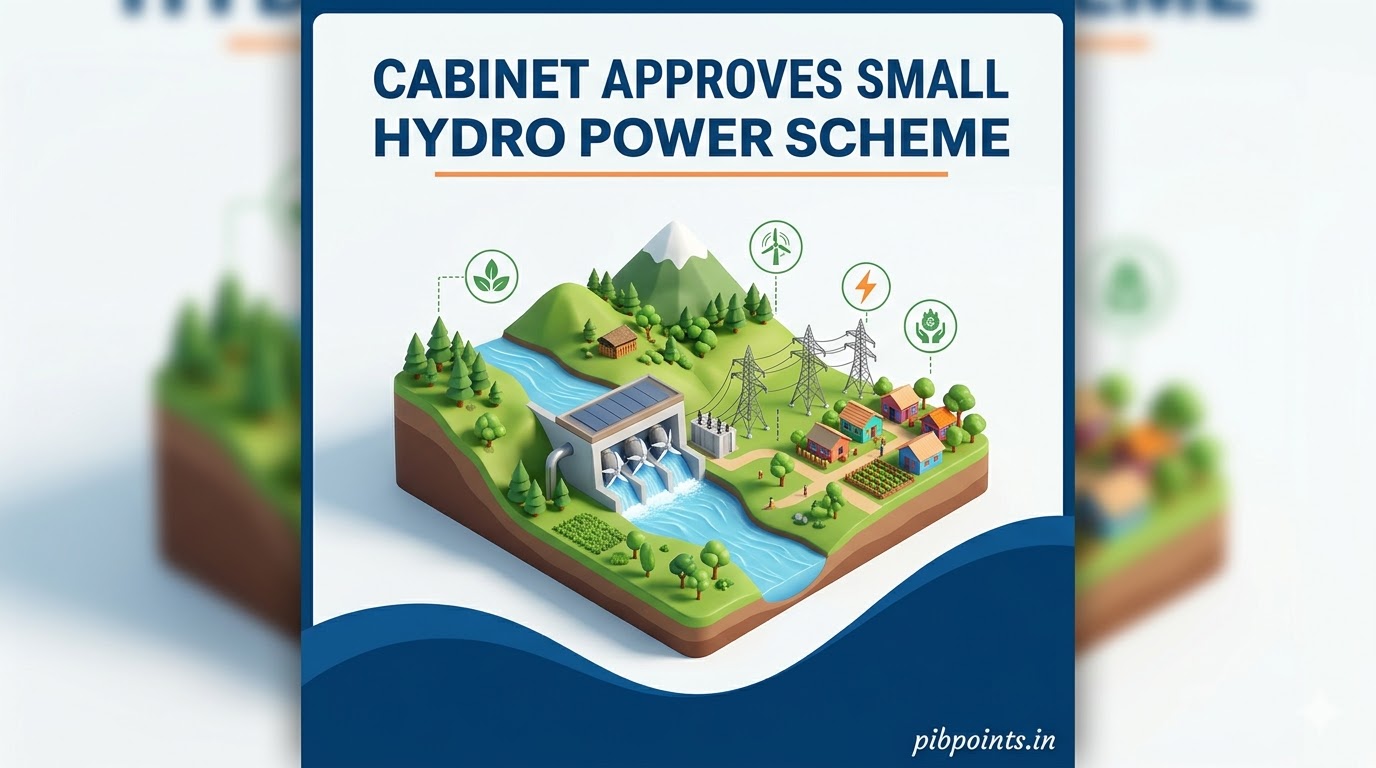
The Union Cabinet, led by Prime Minister Shri Narendra Modi, has officially greenlit the Small Hydro Power (SHP) Development Scheme. With a massive financial outlay of Rs. 2,584.60 crore, this initiative aims to transform India’s renewable energy landscape between FY 2026-27 and FY 2030-31.
By targeting a capacity of 1,500 MW, the government is focusing on decentralized, eco-friendly energy solutions for rural and hilly terrains.
What is the Small Hydro Power (SHP) Scheme?
The SHP Development Scheme is a strategic initiative by the Ministry of New and Renewable Energy (MNRE). It provides financial backing for small-scale hydroelectric projects with a capacity ranging from 1 MW to 25 MW. Unlike large dams, these projects are “run-of-the-river,” meaning they have minimal environmental impact and do not require massive displacement of local communities.
Scheme Overview: 2026-2031
| Feature | Details |
| Total Budget | Rs. 2,584.60 Crore |
| Target Capacity | 1,500 MW |
| Project Range | 1 MW to 25 MW |
| Implementing Agency | MNRE |
| Private Investment Goal | Rs. 15,000 Crore |
Financial Assistance & Subsidies
The government has structured the Central Financial Assistance (CFA) to prioritize difficult terrains like the North Eastern states and border areas.
1. North Eastern & Border Districts
- Subsidy: Rs. 3.6 crore per MW or 30% of project cost (whichever is lower).
- Maximum Cap: Rs. 30 crore per project.
2. Other States/General Category
- Subsidy: Rs. 2.4 crore per MW or 20% of project cost (whichever is lower).
- Maximum Cap: Rs. 20 crore per project.
Pro Tip for Developers: The scheme also allocates Rs. 30 crore specifically for the preparation of Detailed Project Reports (DPRs), covering roughly 200 upcoming projects.
Why This Matters: Impact & Benefits
The SHP Scheme isn’t just about electricity; it’s a socio-economic catalyst:
- Job Creation: The construction phase alone is expected to generate 51 lakh person-days of employment.
- Atmanirbhar Bharat: A mandatory 100% of plant and machinery must be sourced from indigenous manufacturers, boosting the local engineering sector.
- Eco-Friendly Power: Small hydro avoids the deforestation and land acquisition issues associated with large-scale reservoirs.
- Energy Security: By utilizing remote river streams, hilly regions can achieve energy independence with low transmission losses.
Comparison: Small Hydro vs. Large Hydro
Understanding the difference is crucial for competitive exams and policy analysis:
- Size: SHP is strictly 1 MW–25 MW; Large Hydro exceeds 25 MW.
- Environmental Impact: SHP has a negligible carbon footprint and preserves local biodiversity.
- Gestational Period: Small hydro projects can be commissioned much faster than large-scale dams.
Key Facts for Competitive Exams (UPSC, SSC, State PSC)
- Approval Date: March 18, 2026.
- Operational Period: 5 Years (2026-27 to 2030-31).
- Sector Focus: Rural, Remote, and Hilly regions.
- Source of Data: PIB Release ID: 2241799.
Frequently Asked Questions (FAQs)
Q1. Who can apply for the SHP Scheme?
Private developers, state agencies, and local bodies are eligible to apply through the MNRE portal, provided the project falls within the 1 MW to 25 MW range.
Q2. Does this scheme cover solar-hydro hybrids?
While the primary focus is Small Hydro, the infrastructure created often paves the way for integrated renewable grids.
Q3. How long is the lifespan of an SHP project?
These projects are incredibly durable, typically boasting a functional life of 40 to 60 years.
Comments are closed.