
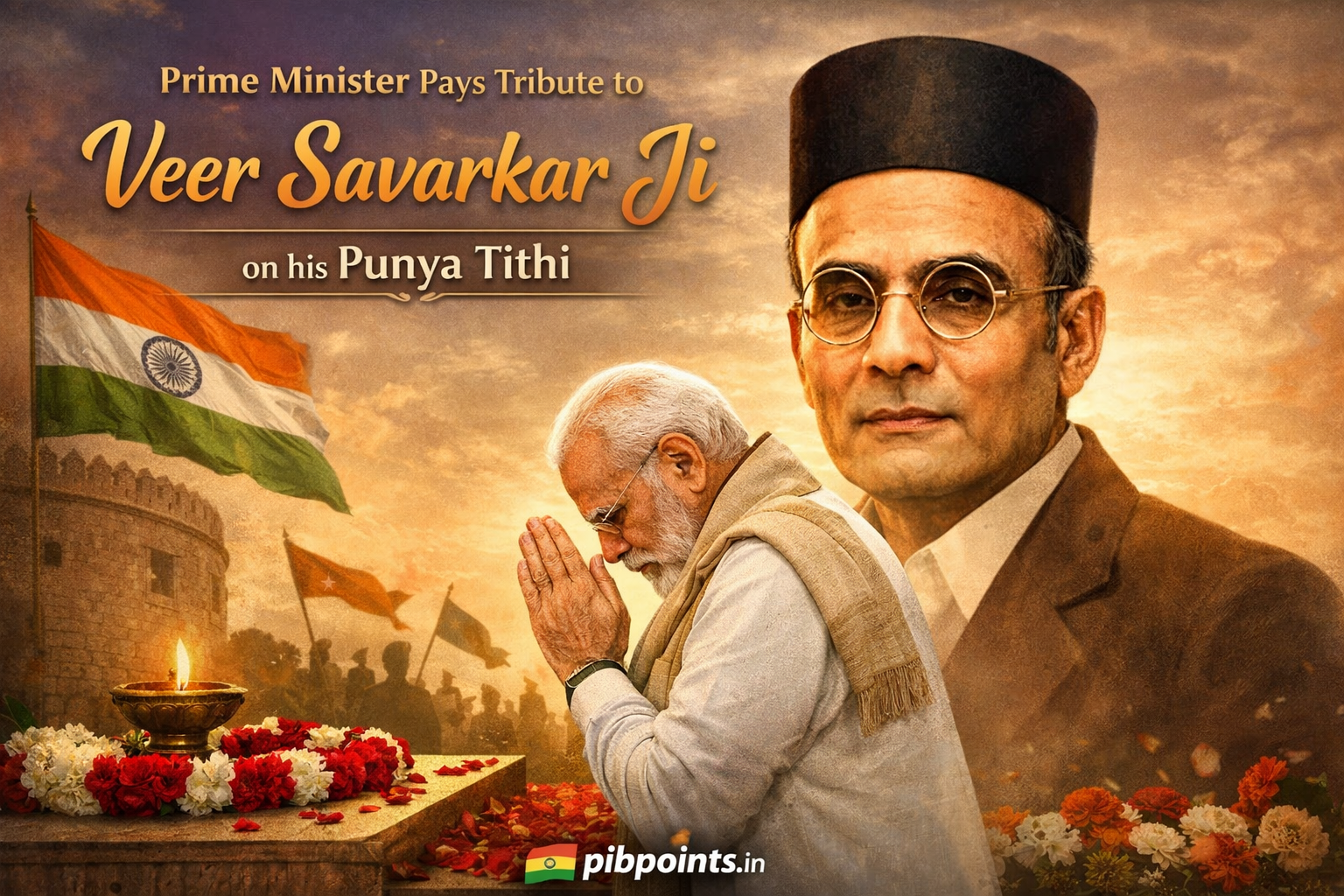
Prime Minister Narendra Modi paid humble tributes to the great revolutionary Veer Savarkar on his Punyatithi, recalling his lifelong dedication to freeing India from colonial rule and his enduring inspiration for national service.
महान क्रांतिकारी वीर सावरकर जी को उनकी पुण्यतिथि पर सादर नमन। देश को गुलामी की जंजीरों से मुक्त कराने के लिए उन्होंने अपना जीवन समर्पित कर दिया। उनका व्यक्तित्व और कृतित्व हर पीढ़ी को राष्ट्रसेवा के लिए प्रेरित करता रहेगा।
— Narendra Modi (@narendramodi) February 26, 2026
Key Highlights at a Glance
| Aspect | Details |
|---|---|
| Full Name | Vinayak Damodar Savarkar |
| Popular Title | Veer Savarkar (The Brave) |
| Birth | 28 May 1883, Bhagur (near Nashik, present-day Maharashtra) |
| Death / Punyatithi | 26 February 1966, Bombay (now Mumbai) |
| Major Roles | Revolutionary, writer, thinker, social reformer, leader of Hindu Mahasabha |
| Ideological Legacy | Systematised the modern concept of Hindutva |
| Notable Work | Book on the 1857 uprising, presenting it as the First War of Indian Independence |
| Key Experience | Harsh imprisonment at the Cellular Jail, Andamans (Kala Pani) |
PM Modi’s Message and Context
On 26 February 2026, Prime Minister Narendra Modi offered respectful homage to Veer Savarkar on his death anniversary, describing him as a great revolutionary hero and a tireless champion of India’s freedom.
In his message, the Prime Minister underlined that Veer Savarkar dedicated his entire life to freeing Bharat from the shackles of slavery and that his life and work will continue to inspire every generation to serve the nation.
The tribute portrayed Savarkar as a symbol of courage, sacrifice and unwavering nationalism, whose ideas remain relevant in contemporary India.
Life of Veer Savarkar: A Brief Biography
Veer Savarkar’s full name was Vinayak Damodar Savarkar, and he is fondly remembered as “Veer Savarkar” for his exceptional bravery and revolutionary zeal.
Born on 28 May 1883 in Bhagur village near Nashik, he grew up in a Chitpavan Brahmin family where patriotic ideas and resistance to foreign rule left a deep imprint on his young mind.
He passed away on 26 February 1966 in Bombay (now Mumbai), and this day is observed across the country as his Punyatithi, a day of solemn remembrance and homage.
Throughout his life, Savarkar emerged as a multifaceted personality – a revolutionary, a prolific writer, a powerful orator, an original thinker and a leading figure of the Hindu Mahasabha.
Role in India’s Freedom Struggle
In Nashik, Savarkar founded the secret revolutionary organisation “Mitra Mela”, which later evolved into “Abhinav Bharat”, becoming a crucial centre of the armed freedom movement.
In 1906, he went to London to study law and soon turned India House and the Free India Society into hubs of nationalist activity, mobilising Indian students for the cause of complete independence.
Through meetings, lectures and underground literature, he mentored young revolutionaries and helped build a transnational network of patriots committed to ending British rule in India.
Literary Contribution and the 1857 Uprising
One of Savarkar’s most influential works was his book on the 1857 uprising, in which he powerfully argued that it was not a mere “sepoy mutiny” but the First War of Indian Independence.
The work was considered so radical and inspiring that the British authorities banned it even before formal publication, and possessing it could lead to severe punishment.
This reinterpretation of 1857 instilled a sense of historical pride and resistance among Indian nationalists and became a major ideological pillar for later freedom fighters.
Cellular Jail and the ‘Kala Pani’ Experience
For his revolutionary activities, Savarkar was sentenced to 50 years of rigorous imprisonment and transported to the dreaded Cellular Jail in the Andaman and Nicobar Islands, infamously known as “Kala Pani”.
In this remote prison, he endured extremely harsh conditions – from grueling physical labour such as operating the oil mill to solitary confinement and relentless punishments.
Despite these hardships, Savarkar continued to compose poems, reflect deeply on national questions and maintain an unbroken resolve to see India free.
His jail writings reveal a rare combination of mental resilience, philosophical depth and unshakeable patriotism in the face of severe adversity.
Post-Release Activities and Political Role
After his release from the Andamans, Savarkar was kept under restrictions in Ratnagiri, where he devoted himself to social reform and local community work.
When major restrictions were relaxed around 1937, he emerged as a prominent national leader of the Hindu Mahasabha, travelling and addressing public meetings across India.
During the Second World War, he coined the slogan of “Hinduisation of politics and militarisation of Hindus”, urging youth to gain military training by joining the armed forces.
He opposed the Congress-led Quit India Movement and advocated an alternative strategy, which marked a clear departure from the mainstream nationalist line of that time.
Social Reform and Campaign Against Caste
Savarkar strongly criticised the rigid caste system, calling it a serious obstacle to the unity and strength of Hindu society.
He supported and promoted inter-dining, inter-caste marriages and the opening of temples to all sections, including communities that had long faced untouchability.
In Ratnagiri, he undertook practical experiments and campaigns aimed at eradicating untouchability and welding different castes into a single, cohesive Hindu social fold.
Through these efforts, he envisioned a socially integrated community that could contribute more effectively to nation-building.
Ideology of Hindutva: Core Ideas
Veer Savarkar is widely regarded as a principal modern architect of the ideology of Hindutva, which he articulated in a systematic and conceptual form.
In the early 1920s, he wrote the essay “Essentials of Hindutva”, which later expanded into the full-length work “Hindutva: Who is a Hindu?”.
In these writings, he defined Hindutva not merely as a religion, but as a broader cultural and civilisational identity rooted in the history and traditions of India.
Key Elements of Savarkar’s Hindutva
- A common nation: a shared territorial and historical experience within Bharat.
- A common culture: language, customs, festivals and ways of life that evolved on Indian soil.
- A shared bond with the land: those who see India as both their fatherland and their holy land form the core of the Hindu nation as he conceived it.
Savarkar preferred the term “Hindutva” over “Hinduism”, asserting that it captured the full spectrum of cultural-national identity rather than being limited to a set of religious doctrines.
Views on Nationhood and Communities
In his earlier writings, Savarkar highlighted the 1857 uprising as an example of Hindu–Muslim unity against British rule, but his views on communal relations evolved over time.
Later, he spoke of Hindus and Muslims as two distinct political communities in India and articulated a more defined concept of a Hindu nation alongside the Muslim League’s demand for a separate Muslim nation.
These ideas continue to be central to present-day debates on nationalism, secularism and minority rights in India.
Controversies, Criticism and Ongoing Debates
Some historians argue that after his release from the Andamans, Savarkar did not return to direct confrontation with British rule and instead concentrated on ideological work and organisational politics.
His opposition to the Quit India Movement and his stance during the Second World War, when he encouraged Hindus to join the British Indian armed forces for training, have been subject to intense scrutiny.
He was made an accused in the assassination case of Mahatma Gandhi but was acquitted by the court due to lack of sufficient evidence, though public and political controversy still surrounds this episode.
Supporters celebrate him as a great revolutionary, visionary nationalist and social reformer, while critics see some aspects of his Hindutva as potentially exclusionary towards minorities.
Relevance of Veer Savarkar in Contemporary India
Prime Minister Modi’s tribute underscores that Savarkar’s life of courage, discipline and sacrifice continues to inspire countless young Indians to dedicate themselves to the service of the nation.
His reinterpretation of 1857 and his articulation of Hindutva remain important reference points in ongoing discussions about national identity, cultural heritage and statecraft.
From a social perspective, his advocacy of caste abolition, opposition to untouchability and emphasis on social harmony still offer a powerful framework for internal reform within Indian society.
Remembering Veer Savarkar on his Punyatithi is, therefore, not only an act of homage to a towering figure of India’s freedom struggle, but also an invitation to reflect on how individual conviction and organised effort can shape the destiny of a nation.
Sources
- Prime Minister’s Office – “PM Pays Tribute to Veer Savarkar Ji on his Punya Tithi”, PM India website .
- Press Information Bureau – “Prime Minister Pays Tribute to Veer Savarkar Ji on his Punya Tithi”, pib.gov.in .
- All India Radio / NewsOnAir – “PM Modi Pays Tribute to Veer Savarkar on his Death Anniversary”, newsonair.gov.in .
- Times of India – “PM Modi pays tributes to Veer Savarkar on his death anniversary”, timesofindia.indiatimes.com .
- India Today – “PM Modi honours Veer Savarkar on his death anniversary”, indiatoday.in .
[…] our coverage of PM Modi’s Profound, Soul-Stirring Tribute to Veer Savarkar, we discussed how leadership narratives often emphasize sacrifice and service. The OPS–NPS–UPS […]