
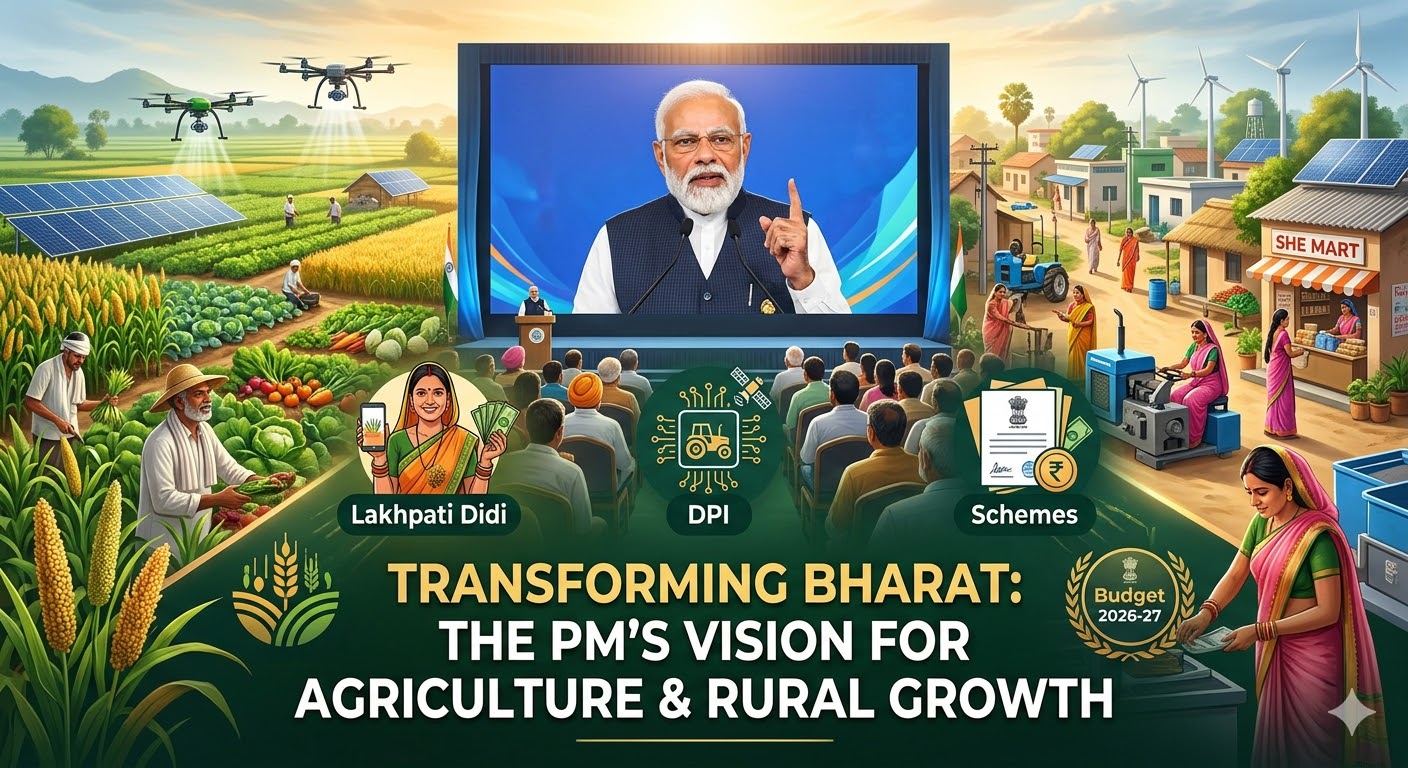
The Union Budget 2026-27 marks a watershed moment for India’s primary sector. Moving beyond mere food security, the government’s latest roadmap envisions a globally competitive, technology-driven, and export-oriented agricultural landscape. During the recent Post-Budget Webinar on “Agriculture and Rural Transformation,” Prime Minister Narendra Modi laid out a strategic blueprint that bridges the gap between traditional farming and modern economic requirements.
Post-Budget Webinar on Agriculture and Rural Transformation
To watch the full highlights of the Prime Minister’s address, you can view the official session here:
For aspirants and policy enthusiasts focusing on GS3 (Economy and Rural Development), this address highlights the shift from “subsistence to surplus” and “production to value-addition.”
1. The Strategic Pillars: Beyond Traditional Farming
The Prime Minister emphasized that agriculture is not just a sector but the “Strategic Pillar” of India’s long-term developmental journey. The address highlighted how the government has systematically de-risked the sector through:
- PM Kisan Samman Nidhi: Over ₹4 lakh crore transferred directly to 10 crore farmers.
- PM Fasal Bima Yojana: Settlement of claims worth nearly ₹2 lakh crore.
- Institutional Credit: Coverage has now breached the 75% mark, ensuring farmers are less dependent on informal, high-interest debt.
2. High-Value Agriculture: The New Frontier
A significant takeaway from the webinar was the focus on Agro-Climatic Zone-specific promotion. Instead of a one-size-fits-all approach, the Budget 2026-27 proposes:
- Southern States (Kerala/Tamil Nadu): Rejuvenation of aging coconut plantations and cashew promotion.
- North East: Scaling up Agarwood (the source of ‘agarbatti’) to tap into global fragrance markets.
- Himalayan Region: Promoting Temperate Nut crops like walnuts and almonds.
- Strategic Export Crops: Focus on Cocoa and Sandalwood to reduce import dependency and boost rural employment through local processing.
3. Digital Public Infrastructure (DPI): The ‘Bharat Vistaar’ Initiative
Technology is the “force multiplier” in this transformation. The PM introduced Bharat Vistaar, an AI-powered Digital Public Infrastructure for Agriculture.
- AgriStack: Creating a unified digital identity for farmers to streamline benefit delivery.
- Digital Land Surveys: Ensuring transparency in land records and ease of credit.
- Precision Farming: Using AI to provide real-time data on soil health, weather, and market prices.
4. Women as Economic Leaders: The Lakhpati Didi Revolution
The Lakhpati Didi scheme is a cornerstone of rural transformation. Having already achieved the initial target of 3 crore women 15 months ahead of schedule, the PM set an ambitious new goal: creating 3 crore more Lakhpati Didis by 2029.
- SHE MARTS: The government plans to establish one ‘SHE MART’ in every district to provide a direct retail interface for products made by women Self-Help Groups (SHGs).
- Entrepreneurship: Transitioning SHGs from micro-credit groups to formal rural enterprises.
5. The Blue and White Revolution 2.0
The webinar also touched upon the “Allied Sectors”:
- Fisheries: India is already the 2nd largest producer. The PM identified a potential to add 20 lakh tonnes to current production through the development of reservoirs and the Exclusive Economic Zone (EEZ).
- Animal Husbandry: A focus on “One Earth, One Health” with massive vaccine drives (125 crore+ doses for Foot and Mouth Disease) and the National Gokul Mission.
- Waste to Wealth: Under the Gobardhan Scheme, cow dung is being utilized for energy security and keeping villages clean.
Conclusion: The Road to Viksit Bharat
The transition to Chemical-free and Natural Farming is no longer a choice but a necessity to meet global health standards. As the PM noted, “Natural farming is the highway to global markets.” By integrating technology with tradition and empowering the rural workforce—especially women—India is setting the stage for an agrarian revolution that is sustainable, profitable, and globally relevant.