
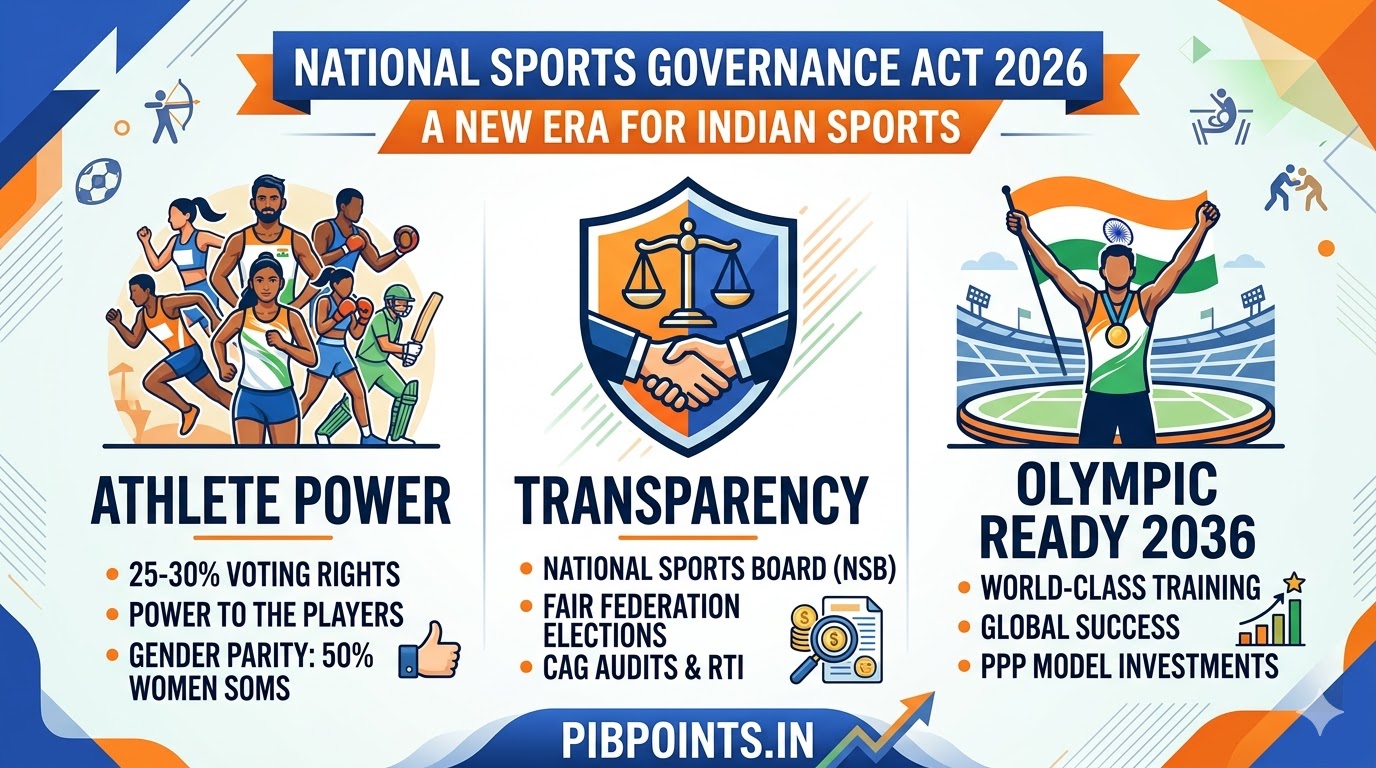
On March 15, 2026, the Government of India reiterated its commitment to transforming the nation into a global sporting powerhouse by 2047. Central to this vision is the National Sports Governance Act 2025 and the newly notified National Sports Governance (National Sports Bodies) Rules, 2026.
For a country aiming to host the 2036 Olympic Games, these reforms are being hailed as the “single biggest sports reform since independence.”
National Sports Governance Act 2025: Key Changes at a Glance
- Athlete Power: Mandatory 25% to 30% voting rights for Sportspersons of Outstanding Merit (SOMs) in all federations.
- Gender Parity: 50% of SOMs in the General Body must be women.
- New Watchdog: Establishment of the National Sports Board (NSB) to regulate recognition and funding.
- Faster Justice: Creation of a Sports Appellate Tribunal for time-bound dispute resolution.
- Age & Tenure: Strict cap of 70 years for office bearers (aligned with International Olympic Committee standards).
Why This National Sports Governance Act 2025 Matters for India
The primary goal is to bring transparency, accountability, and athlete-centricity to National Sports Federations (NSFs). By aligning Indian sports bodies with the Olympic Charter and international best practices, the Act ensures that administrative hurdles don’t stop our athletes from winning gold.
Key Features of the National Sports Governance Rules 2026
1. Power to the Athletes (The 25% Rule)
For the first time, athletes are not just players; they are decision-makers.
- Sportspersons of Outstanding Merit (SOMs): Every National Sports Body must include SOMs in its General Body.
- Voting Rights: SOMs will hold at least 25% to 30% of the voting strength in the General Body and Executive Committees.
- Gender Parity: The rules mandate 50% representation for women among the SOMs to ensure an inclusive sporting environment.
2. The National Sports Board (NSB)
A new regulatory authority, the National Sports Board, has been established.
- It acts as the central authority for granting recognition to National Sports Bodies.
- It has the power to de-recognize federations that fail to conduct fair elections or mismanage government funds.
3. Sports Appellate Tribunal
To reduce the burden on civil courts, the Act introduces a Sports Appellate Tribunal. This body will adjudicate all sports-related disputes, including selection grievances and election issues, in a time-bound manner.
4. Financial Accountability
- All recognized sports bodies receiving government funding now fall under the Right to Information (RTI) Act.
- Their finances are subject to audit by the Comptroller and Auditor General (CAG) of India.
5. Age and Tenure Limits
To prevent “dynasty politics” in sports federations:
- The Act enforces strict age and tenure limits for office bearers.
- Generally, the age cap is 70, though some exceptions (up to 75 years) exist if permitted by international federations.
Impact on India’s Sports Economy
Speaking on March 15, the Raksha Mantri emphasized that this Act works in tandem with the Public-Private Partnership (PPP) model. By providing a stable legal framework, the government is encouraging private players to invest in world-class coaching, sports science, and infrastructure.
Quick Summary for Competitive Exams
| Feature | Details |
| Primary Goal | Transparency & Athlete Welfare |
| Athlete Representation | At least 25-30% in decision-making bodies |
| New Authority | National Sports Board (NSB) |
| Dispute Redressal | Sports Appellate Tribunal |
| Host Ambition | Preparing India for 2036 Olympic Bid |
Conclusion
The National Sports Governance Act 2025 is a massive leap toward a Viksit Bharat in the field of sports. It moves the focus from “administrators” to “athletes,” ensuring that India’s sports ecosystem is ready to compete with the best in the world.
Frequently Asked Questions (FAQs) on National Sports Governance Act 2026
1. What is the National Sports Governance Act 2025?
It is a comprehensive legal framework introduced by the Government of India to regulate National Sports Federations (NSFs). It aims to improve transparency, ensure athlete-centric governance, and align India’s sports administration with the International Olympic Committee (IOC) standards.
2. How does the 25% voting rule benefit athletes?
Under the new rules, Sportspersons of Outstanding Merit (SOMs) must make up at least 25% to 30% of the voting strength in the General Body and Executive Committees of sports federations. This ensures that actual players, rather than just politicians or bureaucrats, have a say in how their sport is managed.
3. Who is considered a ‘Sportsperson of Outstanding Merit’ (SOM)?
An SOM is typically defined as an athlete who has represented India at the Olympics, Asian Games, Commonwealth Games, or World Championships. The 2025 Act also mandates that 50% of these SOMs must be women to ensure gender parity.
4. What is the role of the National Sports Board (NSB)?
The National Sports Board acts as the central regulatory authority. It is responsible for:
- Granting or renewing recognition to National Sports Bodies.
- Monitoring the fair conduct of elections.
- Auditing the utilization of government grants.
5. Can athletes appeal against federation decisions?
Yes. The Act establishes a Sports Appellate Tribunal. This body provides a dedicated platform for athletes to resolve disputes regarding selections, disciplinary actions, or election grievances without having to wait years in civil courts.
6. Are sports bodies now under the RTI Act?
Yes. All recognized National Sports Bodies that receive financial assistance or administrative support from the government are now fully covered under the Right to Information (RTI) Act, ensuring total financial transparency.
7. Is there an age limit for sports administrators?
Yes. To bring in fresh leadership, the Act enforces a strict age cap of 70 years and specific tenure limits for office bearers, preventing individuals from holding power indefinitely.
Official Sources & Links
For researchers and students, please refer to these primary documents:
- Full Act: The National Sports Governance Act, 2025 (India Code)
- Notification of Rules: PIB Release: National Sports Governance Rules, 2026
- Commencement Order: Ministry of Youth Affairs & Sports (PIB Release ID: 2210321)
For more updates on Indian Government Schemes and PIB Releases, stay tuned to pibpoints.in.
Comments are closed.