
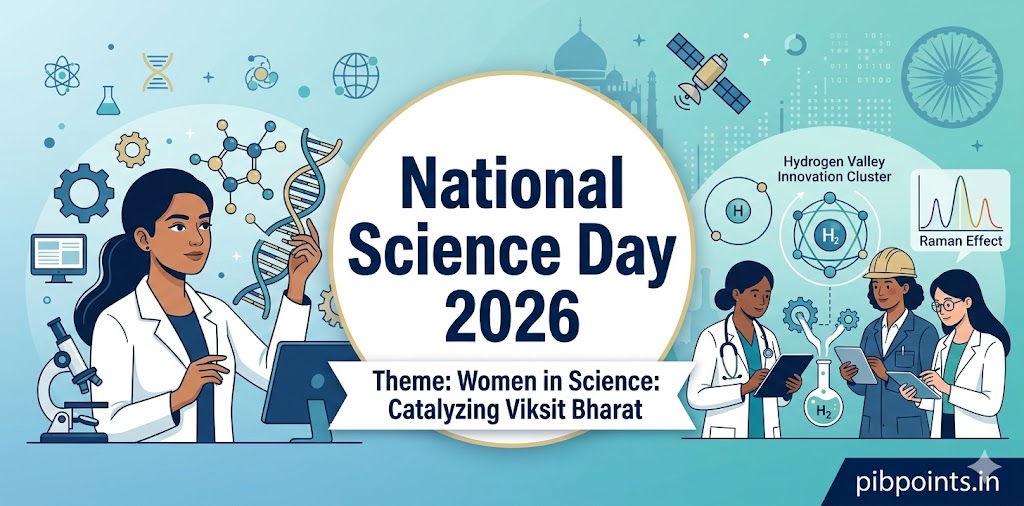
Quick Bites: National Science Day 2026 Highlights
- Official Theme: “Women in Science: Catalyzing Viksit Bharat.”
- Historical Event: Commemorates the discovery of the Raman Effect (Feb 28, 1928).
- Nobel Glory: Sir C.V. Raman won the Nobel Prize in Physics in 1930 for this discovery.
- National Recognition: Declared by the Government of India in 1986; first celebrated in 1987.
- 2026 Key Milestone: 40% of Indian science patents are now filed by women.
- Major Launch: Dr. Jitendra Singh inaugurates the Hydrogen Valley Innovation Cluster.
Every year on February 28, India celebrates National Science Day (Rashtriya Vigyan Diwas) to honor one of the most iconic moments in global scientific history—the discovery of the Raman Effect by Sir Chandrasekhara Venkata Raman. In 2026, the celebration takes on a transformative theme: “Women in Science: Catalyzing Viksit Bharat.” This year’s event, hosted by Union Minister Dr. Jitendra Singh at the INSA Auditorium in New Delhi, highlights a shift toward a mission-driven scientific ecosystem where women are the primary drivers of innovation and self-reliance (Atmanirbhar Bharat).
The Science Behind the Discovery: What is the Raman Effect?
According to historical records and scientific archives cited by Livemint, the Raman Effect refers to the phenomenon where light changes its wavelength when it is deflected by molecules.
The Moment of Discovery
On February 28, 1928, while working at the Indian Association for the Cultivation of Science (IACS) in Kolkata, Sir C.V. Raman observed that when a beam of light traverses a dust-free, transparent sample of a chemical compound, a small fraction of the light emerges in directions other than that of the incident beam. Most of this scattered light is of an unchanged wavelength, but a small part has different wavelengths.
This discovery was revolutionary because it provided proof of the quantum nature of light and opened a new window into the molecular structure of compounds.
Nobel Prize and Global Impact
For this landmark achievement, Sir C.V. Raman was awarded the Nobel Prize in Physics in 1930. He was the first Asian and the first non-white individual to receive a Nobel Prize in any scientific field. Today, Raman Spectroscopy is used globally in:
- Medicine: Identifying cancer cells and drug testing.
- Space Exploration: Analyzing the composition of planets and stars.
- Security: Detecting explosives and narcotics at airports.
National Science Day 2026: Theme & Significance
The 2026 theme, “Women in Science: Catalyzing Viksit Bharat,” underscores a pivotal change in India’s R&D landscape.
The Multiplier Effect of Women in STEM
Dr. Jitendra Singh highlighted that women are no longer just participants; they are catalysts for economic growth. Statistics revealed during the 2026 celebrations show that:
- 40% of Science Patents in India are now filed by women.
- 43% of STEM graduates in India are women, one of the highest ratios globally.
- The government’s goal is to push R&D spending to 1% of the GDP, with a heavy focus on gender-inclusive research.
Why February 28?
The date was officially designated by the Government of India in 1986 following a proposal by the National Council for Science and Technology Communication (NCSTC). The goal was to build a “scientific temper” among citizens—encouraging logic, evidence-based thinking, and a departure from superstition.
Major Launches & Announcements (NSD 2026)
| Initiative | Impact & Goal |
| Hydrogen Valley Innovation Cluster | Creating clean energy hubs to lead the global green hydrogen market. |
| ANRF-Venture Centre Outreach | Helping young scientists turn laboratory research into successful startups. |
| “Engage with Science” Program | A residential internship for Class 8-9 students at 16 DST institutions. |
| Nano Titania Technology | Using nanotechnology to preserve national heritage monuments like the Taj Mahal. |
| Mission Innovation India Report | Tracking India’s shift toward 500GW of non-fossil energy by 2030. |
Education & Public Engagement
National Science Day is a massive mobilization effort. In 2026, over 50,000 schools and 5 million participants joined nationwide activities.
- IISER Pune and the Raman Research Institute (RRI) in Bengaluru held “Open Days,” where children experimented with light scattering demonstrations.
- The Homi Bhabha Centre in Mumbai hosted rocket shows and sunspot observations.
These events aim to bridge the gap between complex laboratory research and the common citizen, making science “real” for the next generation.
Frequently Asked Questions (FAQs)
Q1: Is National Science Day C.V. Raman’s birthday?
No. Sir C.V. Raman was born on November 7. National Science Day is celebrated on February 28 to mark the date he discovered the Raman Effect.
Q2: Who was the first person to suggest National Science Day?
The idea was proposed by the National Council for Science and Technology Communication (NCSTC) and accepted by the Government of India in 1986.
Q3: How can schools participate?
Schools can organize science fairs, quiz competitions, and visits to local DST (Department of Science and Technology) labs, which often have “Open Day” policies on Feb 28.
Highlights for pibpoints.in
- Verify Eligibility: For details on the “Engage with Science” residential program, check the official DST Portal.
- Internal Link: Read our recent post on the National HPV Vaccination Drive to see how science is transforming women’s health.
- Official Source: For the original government release, visit PIB India.
Conclusion
National Science Day 2026 is a celebration of both legacy and future. While we honor the 98th anniversary of the Raman Effect, we also look forward to a Viksit Bharat where indigenous technology and women-led innovation define the nation’s success. As Sir C.V. Raman once said, “Success can come to you only if you have the courage to trust your own instincts.” Today, India is trusting its scientific instincts more than ever.
Follow pibpoints.in for daily, in-depth coverage of India’s journey through science, policy, and national progress.