
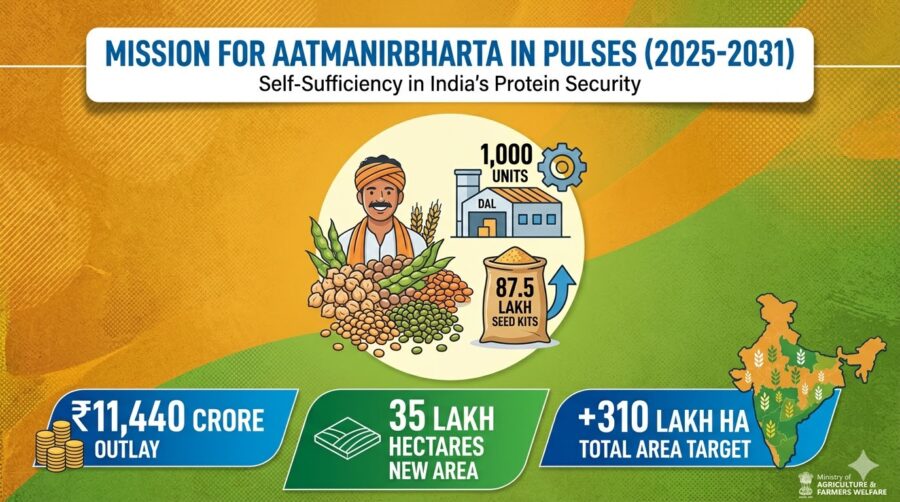
Introduction – Why Pulses Matter for India’s Food Security
Pulses — including lentils (masoor), chickpeas (chana), pigeon pea (arhar/tur), and moong — form the backbone of protein intake for India’s vast vegetarian population. Yet for decades India has remained heavily dependent on imports, especially from Australia, Canada, and Myanmar, to meet domestic demand.
To permanently break this import dependency, the Union Cabinet has approved the ‘Mission for Aatmanirbharta in Pulses’ — a major centrally sponsored scheme aimed at making India fully self-sufficient in pulses production by 2030–31.
Data Table: Mission Targets and Expansion (2024 vs. 2030)
The following table highlights the projected growth in pulses cultivation area under the mission:
| Year | Projected Area (Lakh Hectares) | Growth Status |
| 2024–25 (Base Year) | 276 | Current Baseline |
| 2025–26 | 283 | Phase I Implementation |
| 2030–31 (Target) | 310 | +34 Lakh Ha Increase |
WPI vs. CPI: The Macroeconomic Impact
Understanding the shift in pulses strategy requires looking at inflation indices. While the Wholesale Price Index (WPI) (currently using the 2011-12 base year) tracks bulk prices, pulses have a more direct and volatile impact on the Consumer Price Index (CPI).
Because pulses are a staple protein source, production shortfalls lead to immediate “kitchen inflation.” By targeting self-sufficiency, the government aims to stabilize CPI fluctuations and protect foreign exchange reserves currently spent on imports from Myanmar, Canada, and Australia.
What is the Mission for Aatmanirbharta in Pulses?
| Parameter | Details |
|---|---|
| Scheme Name | Mission for Aatmanirbharta in Pulses |
| Approved by | Union Cabinet |
| Approved on | 1st October 2025 |
| Mission Period | 2025–26 to 2030–31 (6 Years) |
| Financial Outlay | ₹11,440 Crore |
| Nodal Ministry | Ministry of Agriculture & Farmers Welfare |
| Type | Centrally Sponsored Scheme |
| Key Goal | Self-sufficiency (Aatmanirbharta) in pulses production |
Key Components of the Mission
1. Post-Harvest Infrastructure — Processing Units (Dal Mills)
- Total processing units approved: 1,000 units over the mission period
- First phase target: 528 processing units allotted to States and Union Territories
- Purpose: Reduce post-harvest losses and add value to pulses at the farm level
State-wise First Phase Targets (Key States):
| State | Processing Units |
|---|---|
| Uttar Pradesh | 56 |
| Madhya Pradesh | 55 |
| Maharashtra | 34 |
| Karnataka | 30 |
| Rajasthan | 30 |
| Gujarat | 28 |
| Bihar | 37 |
| Jharkhand | 22 |
| Assam | 25 |
| Total (All States) | 528 |
2. Seed Kit Distribution — Boosting Area Coverage
Free seed kits are being distributed to farmers to increase area and production of pulses in rice fallow areas and other diversifiable areas.
Targets over 6 years:
| Year | Seed Kits (in Lakh) |
|---|---|
| 2025–26 (Rabi) | 10.36 lakh (already allocated) |
| 2026–27 | 15.00 lakh |
| 2027–28 | 16.25 lakh |
| 2028–29 | 17.50 lakh |
| 2029–30 | 13.75 lakh |
| 2030–31 | 12.50 lakh |
| Total (6 Years) | 87.5 lakh seed kits |
Top States receiving Seed Kits in Rabi 2025–26:
| State | Seed Kits |
|---|---|
| Madhya Pradesh | 2,22,700 |
| Uttar Pradesh | 2,11,000 |
| Rajasthan | 1,28,700 |
| Andhra Pradesh | 96,200 |
| Maharashtra | 95,000 |
| Tamil Nadu | 82,500 |
| Jharkhand | 12,000 |
| Total | 10,36,780 |
3. Focus Districts — Cluster-Based Approach
- 489 districts have been identified as focus districts for intensive pulses cultivation clusters across India
- The list can be modified based on changing local requirements
- Jharkhand has 22 focus districts under the mission
4. Area Expansion Targets
The mission projects the total pulses cultivation area to expand by 35 lakh hectares by 2030–31:
- 24.5 lakh hectares in traditional areas
- 10.5 lakh hectares in non-traditional areas
All-India Projected Area (in Lakh Hectares):
| Year | Projected Area (Lakh Ha) |
|---|---|
| 2024–25 (Base) | 276 |
| 2025–26 | 283 |
| 2026–27 | 286 |
| 2027–28 | 291 |
| 2028–29 | 298 |
| 2029–30 | 305 |
| 2030–31 | 310 |
This represents an increase of ~34 lakh hectares from the 2024–25 base to 2030–31.
Why This Scheme Is Significant — Key Reasons
A. India’s Pulses Import Burden
India is one of the world’s largest consumers of pulses but has historically been a net importer. Import of pulses puts pressure on foreign exchange reserves and makes domestic prices volatile — directly affecting common households and inflation indices.
B. Link with Food Inflation
Pulses prices are a key component of the Consumer Price Index (CPI). Production shortfalls directly push inflation — making this mission a tool of macroeconomic stability as much as an agriculture scheme.
C. Nutritional Security
Pulses are the cheapest and most accessible source of protein for India’s vegetarian population. The mission directly supports the national goal of nutritional security and aligns with the PM Poshan Shakti Nirman priorities.
D. Viksit Bharat 2047 Alignment
The mission’s 2030–31 target is a stepping stone toward the broader Viksit Bharat goal of making India a developed nation by 2047 — with a self-reliant agricultural economy as its foundation.
Key Differences: Mission vs. Earlier Pulses Initiatives
| Parameter | Earlier Schemes | Mission for Aatmanirbharta in Pulses |
|---|---|---|
| Duration | Mostly annual | 6 years (2025–2031) |
| Financial outlay | Fragmented | ₹11,440 Crore integrated |
| Focus | Production subsidy | Production + Post-harvest + Seed distribution |
| Area approach | General | Cluster-based (489 districts) |
| Processing infra | Limited | 1,000 dal mills |
Expected Prelims Question Pattern:
“Which of the following is NOT a feature of the Mission for Aatmanirbharta in Pulses?”
or
“Consider the following statements regarding the Mission for Aatmanirbharta in Pulses…”
Quick Revision Box — One-Liner Facts
- Approved on: 1 October 2025 by Union Cabinet
- Period: 2025–26 to 2030–31 (6 years)
- Outlay: ₹11,440 Crore
- Processing units: 1,000 total; 528 in Phase-I
- Free seed kits: 87.5 lakh over 6 years
- Focus districts: 489 across India
- Area expansion target: +35 lakh hectares by 2030–31
- All-India target area: 310 lakh hectares by 2030–31
- Top beneficiary states: MP, UP, Rajasthan, Maharashtra, Karnataka
- Ministry: Agriculture & Farmers Welfare
Key Components of the Mission
- Post-Harvest Infrastructure: Establishment of 1,000 Dal Mills (processing units) to reduce wastage; 528 units are already allotted in the first phase.
- Seed Kit Distribution: A massive rollout of 87.5 lakh free seed kits over six years to improve yields in rice fallow and non-traditional areas.
- Cluster-Based Approach: Intensive cultivation focusing on 489 identified districts across India.
- Jharkhand Focus: The state is a key beneficiary with 22 focus districts and an allocated 22 processing units in Phase-I.
“Quick Bite” Section: Fast Revision for Aspirants
- Scheme Type: Centrally Sponsored Scheme.
- Financial Outlay: ₹11,440 Crore.
- Timeline: 6 Years (2025–26 to 2030–31).
- Nodal Ministry: Ministry of Agriculture & Farmers Welfare.
- Primary Goal: 310 Lakh Hectares of cultivation area by 2030.
- Top Beneficiaries: Madhya Pradesh, Uttar Pradesh, and Rajasthan.
Source: For the official press release, refer to the Ministry of Commerce & Industry via PIB Release ID: 2240515 (and cross-referenced with PIB Delhi Release ID: 2241411).
FAQ Section (Schema Markup Ready)
Q: What is the primary objective of the Mission for Aatmanirbharta in Pulses?
A: To achieve complete self-sufficiency in pulses production by the year 2030–31, reducing reliance on foreign imports.
Q: How many processing units (Dal Mills) are planned under this mission?
A: A total of 1,000 units are approved, with 528 units being set up in the first phase across various states.
Q: Which states are receiving the most seed kits in the initial phase?
A: Madhya Pradesh (2.22 lakh), Uttar Pradesh (2.11 lakh), and Rajasthan (1.28 lakh) are the leading recipients for the Rabi 2025–26 season.
Q: Is this a Central Sector or Centrally Sponsored Scheme?
A: It is a Centrally Sponsored Scheme, meaning the cost is shared between the Central and State governments.
Comments are closed.