
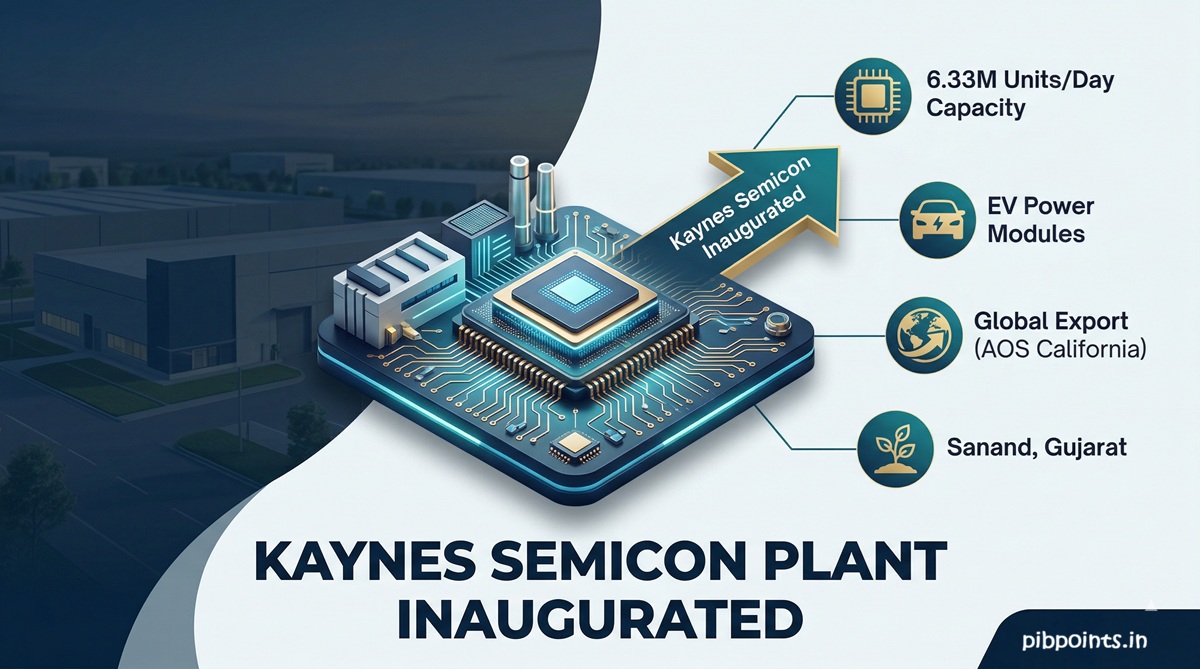
The dream of a self-reliant India in the high-tech electronics space took a massive leap forward yesterday. On March 31, 2026, Prime Minister Narendra Modi officially inaugurated the Kaynes Semicon facility in Sanand, Gujarat. This isn’t just another factory; it is a landmark in the India Semiconductor Mission (ISM) and a signal to the world that India is no longer just a consumer of technology, but a manufacturer capable of shaping the global tech landscape.
The momentum is undeniable. Exactly one month ago, on February 28, the Micron Sanand facility inauguration marked the start of production for India’s first major semiconductor unit. Now, with Kaynes Semicon, Sanand is rapidly transforming into a “Silicon Valley for Hardware,” proving that India’s semiconductor ecosystem is developing with unprecedented speed.
Strategic Significance: A Declaration of Self-Confidence
The inauguration of this plant marks a shift from “design-only” capabilities to a full-stack manufacturing presence. As an OSAT (Outsourced Semiconductor Assembly and Test) and ATMP (Assembly, Testing, Marking, and Packing) unit, Kaynes Semicon sits at the heart of the global supply chain.
Prime Minister Modi emphasized that the India Semiconductor Mission is “not just an industrial policy, but a declaration of India’s self-confidence.” This mission aims to ensure that disruptions in global supply chains—whether caused by pandemics or geopolitical conflicts—no longer impede the progress of humanity. By becoming a reliable supplier, India is positioning itself as a democratic pillar in the global chip market.
Data Table: Kaynes Semicon vs. Global Standards
To understand the scale of this project, we must look at the technical specifications that put Kaynes on the global map.
| Feature | Details |
| Location | Sanand GIDC, Ahmedabad, Gujarat |
| Daily Capacity | 6.33 million units (at full capacity) |
| Flagship Product | Intelligent Power Modules (IPMs) |
| Global Export Partner | Alpha and Omega Semiconductor (AOS), California |
| Core Technology | OSAT / ATMP (Advanced Packaging) |
| Total ISM Projects | 10 projects worth over ₹1,60,000 crore across 6 states |
“Quick Bite” Section: Fast Facts for Social Sharing
- Sanand to Silicon Valley: A new bridge has been built. The modules made in Sanand will be supplied to AOS in California, powering electronics worldwide.
- The “17-Chip” Module: The facility specializes in Intelligent Power Modules (IPMs). Each module contains 17 chips, which are essential for Electric Vehicles (EVs) and heavy industrial tech.
- Indigenous Progress: Alongside these plants, India is developing the Dhruv 64 microprocessor, a secure platform for 5G, automotive, and industrial automation.
- Workforce Readiness: India is on track to train over 85,000 design professionals soon, ensuring that technology development and a skilled workforce go hand in hand.
- Future Energy Synergy: Much like the focus on sustainable energy seen in India’s first OTEC-LTTD project, the Kaynes plant supports the clean energy transition through efficient power electronics.
The Rise of “Silicon Valley for Hardware”
The momentum in Gujarat is undeniable. Exactly one month ago, the Micron Sanand facility marked the start of production for India’s first major semiconductor unit. Now, with Kaynes Semicon, Sanand is rapidly transforming into a “Silicon Valley for Hardware,” proving that India’s semiconductor ecosystem is developing with unprecedented speed.
Comparison: Micron vs. Kaynes Semicon
While both plants are located in the Sanand cluster, they serve different niches in the global supply chain:
- Micron Sanand: Focuses on Memory & Storage (DRAM/NAND). These are the “brains” for PCs and smartphones. It represents a global FDI model processing wafers from overseas.
- Kaynes Semicon: Focuses on Intelligent Power Modules (IPMs). These are the “muscles” for Electric Vehicles (EVs) and industrial automation. Each module integrates 17 different chips into a single unit.
- The Export Bridge: While Micron supplies global tech giants like Dell, Kaynes has built a “Sanand-to-Silicon Valley” bridge, exporting modules to Alpha and Omega Semiconductor (AOS) in California.
Technical Deep-Dive: OSAT and ATMP
As an OSAT (Outsourced Semiconductor Assembly and Test) and ATMP (Assembly, Testing, Marking, and Packing) unit, Kaynes Semicon sits at the heart of the global supply chain. This facility moves India from “design-only” capabilities to a full-stack manufacturing presence.
| Feature | Details |
| Location | Sanand GIDC, Ahmedabad, Gujarat |
| Daily Capacity | 6.33 million units (at full capacity) |
| Flagship Product | Intelligent Power Modules (IPMs) |
| Investment | Over ₹3,300 Crore |
| Core Tech | Advanced Packaging (17-chip modules) |
Strategic Impact: EV Ecosystem and AI
- Strengthening EVs: Local production of IPMs helps Indian automakers reduce reliance on imports, lowering the cost of Electric Vehicles.
- Boosting AI & 5G: A robust chip sector provides the physical foundation for India’s booming AI infrastructure and 5G rollout.
- Global Resilience: By offering a democratic and reliable alternative in the supply chain, India is attracting massive enthusiasm from global investors.
The Next Phase: India Semiconductor Mission 2.0
While the current facility is a massive achievement, the government has already set its sights on the next horizon. ISM 2.0, unveiled in the latest Union Budget, focuses on the domestic production of semiconductor equipment and raw materials.
To secure the necessary resources, India has launched the National Critical Minerals Mission and joined Pax Silica. A ₹1,500-crore scheme for mineral recycling and a Rare Earth Corridor connecting Odisha, Andhra Pradesh, Tamil Nadu, and Kerala are being established to ensure the “heart” of these chips—the minerals—is as resilient as the factories themselves.
What This Means for India’s Electronics Sector
The Indian semiconductor market is currently valued at approximately $50 billion and is projected to cross $100 billion by the end of this decade. The start of production at Kaynes Semicon helps achieve this by:
- Strengthening the EV Ecosystem: IPMs are the “muscles” behind EV motors. Local production helps Indian automakers reduce reliance on imports and lowers costs.
- Boosting AI & 5G: A robust chip sector provides the physical foundation for India’s booming AI and 5G infrastructure.
- Global Resilience: By offering a democratic and reliable alternative in the supply chain, India is attracting massive enthusiasm from global investors.
For the finance and trading community, this move signifies a “moat” for Indian EMS players. Kaynes is not just assembling products; it is moving up the value chain into high-margin, high-demand core technology.
FAQ: Frequently Asked Questions
Q1: What is the significance of the “17-chip” module?
It is an Intelligent Power Module (IPM) that combines 17 chips into one unit. This makes power management in heavy machinery and EVs more efficient and compact.
Q2: Is this part of a larger plan?
Yes. Kaynes is one of 10 major semiconductor projects currently underway in India, representing a total investment of over ₹1.6 lakh crore.
Q3: How does this help the common man?
By manufacturing chips locally, India reduces its import bill, creates thousands of high-tech jobs, and eventually makes electronics and EVs more affordable for domestic consumers.
The Source Line
Source: For the official press release regarding the inauguration, refer to the Prime Minister’s Office via PIB Release ID: 2247278. For technical details on the Sanand facility, refer to PIB Release ID: 2246772.
Final Thoughts:
This decade is what PM Modi calls India’s “Techade.” 21st-century India is no longer a witness to change; it is leading it. From the space sector and quantum computing to the chips powering our vehicles, the Kaynes Semicon plant is a testament to India’s journey toward becoming the “factory of the world.” For investors, tech enthusiasts, and citizens, the message is clear: the future is being packaged in Sanand.
Comments are closed.