
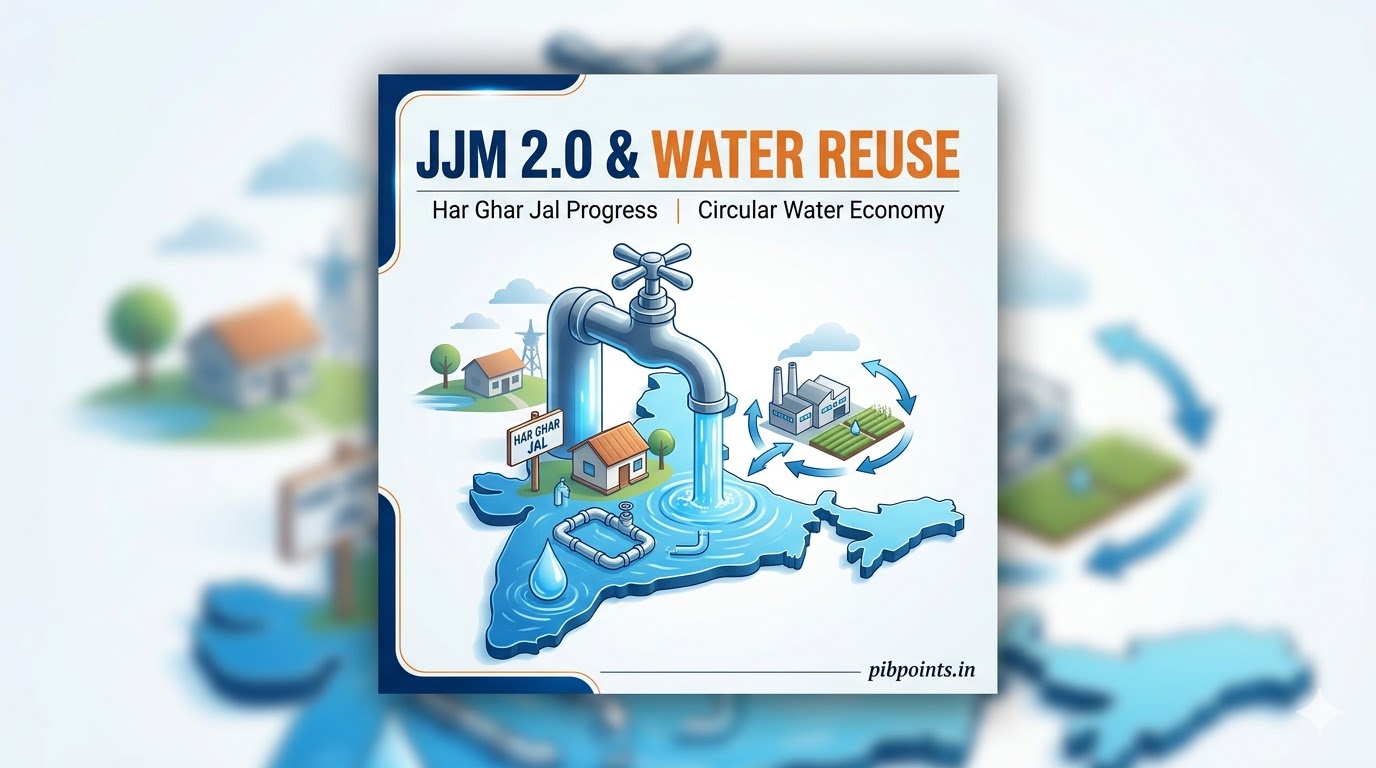
Ministry: Jal Shakti | Date: 17 March 2026 | Source: PIB Delhi (Release IDs: 2241388, 2241229)
Introduction
Two important PIB releases on 17 March 2026 from the Ministry of Jal Shakti update the progress of Jal Jeevan Mission 2.0 (JJM 2.0) and the pioneering Treated Water Reuse Policy notified in Uttarakhand. These are critical topics for UPSC GS-II (Governance, Social Sector) and GS-III (Water Security) and are highly exam-relevant for JPSC aspirants too.
Part 1: Jal Jeevan Mission 2.0 (JJM 2.0)
| Mission | Jal Jeevan Mission 2.0 |
| Objective | Ensure safe tap water supply to every rural household (Har Ghar Jal) |
| JJM 1.0 Period | 2019–24 |
| JJM 2.0 Period | 2024–29 |
| Ministry | Jal Shakti |
| Target | Sustain and extend Har Ghar Jal coverage; focus on water quality and functionality |
| Achievement (JJM 1.0) | Over 15 crore rural households provided tap water connections |
Reform-Linked MoUs: Rajasthan and Madhya Pradesh
Rajasthan and Madhya Pradesh have signed Reform-Linked MoUs under JJM 2.0 with the Central Government. These MoUs bind states to carry out specified water sector reforms in exchange for enhanced Central funding — a new accountability-driven approach to water governance.
- Reform-linked MoUs ensure outcomes, not just outlays
- States commit to water tariff reforms, grievance redressal, and data reporting
- Central funds released in tranches based on reform compliance
- Rajasthan and MP are among the highest-population states — their compliance has national significance
Part 2: Safe Reuse of Treated Water — Uttarakhand Policy
Uttarakhand has become one of the first states in India to formally notify a Safe Reuse of Treated Wastewater Policy. This is a landmark step in India’s circular water economy — ensuring that treated sewage water is safely reused for agriculture, industrial processes, and groundwater recharge rather than being discharged as waste.
Key Aspects of Treated Water Reuse
- Reduces freshwater demand by recycling treated wastewater
- Promotes circular economy in water management
- Applicable for agricultural irrigation (highest water user in India)
- Reduces river pollution from untreated/partially treated sewage discharge
- Supports India’s National Water Policy goal of water conservation
- Aligns with AMRUT 2.0 (Atal Mission for Rejuvenation and Urban Transformation) sewage treatment goals
Significance: Water Security in India
India uses about 90% of its freshwater for agriculture. With groundwater levels declining rapidly and climate change intensifying droughts, treated water reuse is no longer optional — it is existential. India needs 1,200 BCM (Billion Cubic Metres) of water annually but has access to only about 690 BCM of utilisable water resources.
JJM + Water Reuse: Connecting the Dots
| Initiative | Focus | Ministry |
|---|---|---|
| JJM 2.0 | Tap water to every rural home | Jal Shakti |
| AMRUT 2.0 | Sewage treatment in cities | Housing & Urban Affairs |
| Uttarakhand Reuse Policy | Treated water recycling | State + Jal Shakti |
| National Water Policy | Integrated water resources mgmt | Jal Shakti |
Quick Revision Box
- JJM 1.0 achievement: 15 crore+ tap connections in rural India
- JJM 2.0 period: 2024–29
- Reform-linked MoUs signed by: Rajasthan and Madhya Pradesh
- Treated water reuse policy: Uttarakhand (first state to formally notify)
- Ministry: Jal Shakti
- Key goal: Har Ghar Jal — safe tap water for every rural household
Comments are closed.