
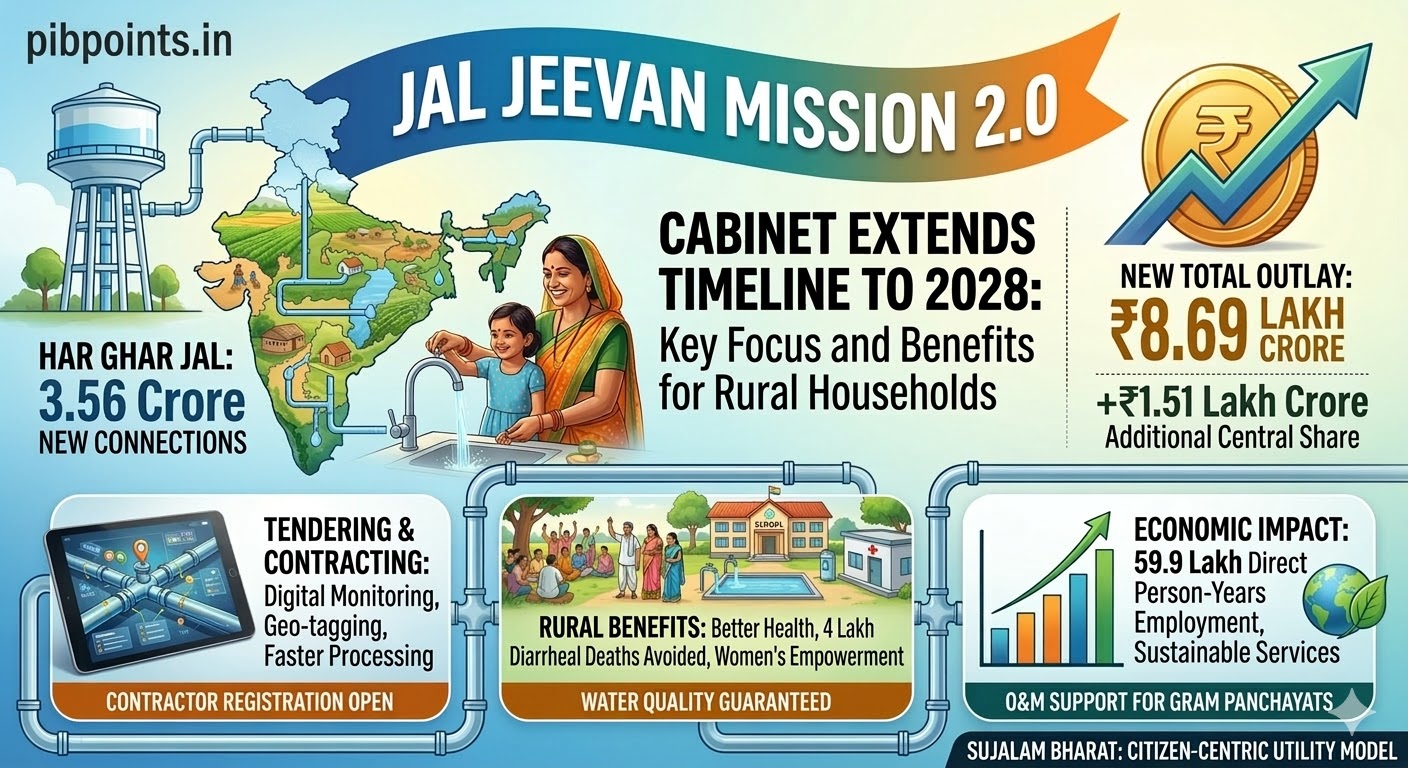
The Union Cabinet has approved the extension of the Jal Jeevan Mission (JJM) up to December 2028, marking the launch of a new phase —Jal Jeevan Mission 2.0. This milestone aims to move beyond providing mere tap connections toward ensuring sustainability, digital integration, and quality water supply for every rural household in India.
For citizens, the update promises more reliable water access, improved health outcomes, and a digitally monitored “Har Ghar Jal” experience.
Jal Jeevan Mission 2.0 – At a Glance
| Feature | Details |
|---|---|
| Scheme Name | Jal Jeevan Mission (JJM) 2.0 |
| Launched By | Government of India, Ministry of Jal Shakti |
| Extended Till | December 2028 |
| Category | Rural Infrastructure / Drinking Water |
| Official Website | jaljeevanmission.gov.in |
Key Highlights of Jal Jeevan Mission 2.0 Extension
- Enhanced Financial Outlay – The government has significantly raised funding to cover all remaining rural households still without tap water.
- Digital “Sujalam Bharat” Framework – Every village will receive a unique Sujal Gaon ID for end-to-end digital mapping, from source to tap.
- Jal Arpan Initiative – Gram Panchayats will now formally take over completed schemes after ensuring funds for operation and maintenance (O&M) are in place.
- Community Ownership – The annual “Jal Utsav” will celebrate local participation and review the health of rural water systems.
- Employment Growth – According to IIM Bangalore and ILO estimates, JJM 2.0 will generate 59.9 lakh direct and 2.2 crore indirect person-years of employment nationwide.
Who Benefits from the Extension?
- Rural Households: Guaranteed supply of 55 litres per person per day.
- Women & Girl Children: Dramatic reduction in water-fetching workloads, freeing time for education and livelihoods.
- Local Communities: Through Jal Shakti Vikas Samitis, villagers gain a stronger voice in managing their own systems.
- Health Benefits: Cleaner drinking water could reduce under-five mortality by nearly 30%.
How to Check Your Village “Har Ghar Jal” Status
- Visit ejalshakti.gov.in.
- Go to the “Village Status” or “Reports” section.
- Select your State → District → Block.
- Click your Village Name to see tap connection progress.
- View if your village is certified “Har Ghar Jal” under the Sujalam Bharat portal.
Financial Details and Central Support
| Parameter | Amount / Detail |
|---|---|
| Total Scheme Outlay | ₹8.69 lakh crore |
| Extension Period | Up to December 2028 |
| Central Share (Total) | ₹3.59 lakh crore |
| 2026–27 Budget Allocation | ₹67,670 crore |
| Average Cost per Connection | ₹40,000–₹50,000 (may rise due to O&M) |
| Digital Platform | “Sujalam Bharat” monitoring network |
The focus of JJM 2.0 shifts from infrastructure delivery to a citizen‑centric utility model, ensuring 24×7 safe water supply.
Contractor Registration and Tender Opportunities
With massive new investment, opportunities for engineers and contractors in water infrastructure are expanding.
How to Apply for JJM Tenders:
- Register with your state’s Jal Shakti Vibhag or Public Health Engineering Department (PHED).
- Choose your contract category (Class A–D) based on financial capacity.
- Submit bids through CPPP or state e‑procurement portals.
- Ensure all projects are geo‑tagged and digitally mapped; payments increasingly depend on functional delivery, not just physical completion.
- Explore the “Nal Jal Mitra” programme for youth skill development and maintenance work.
Benefits Beyond Water Access
- Public Health Gains: WHO estimates universal tap water can prevent nearly 4 lakh diarrheal deaths and save 14 million DALYs.
- Women’s Empowerment: SBI Research notes over 9 crore women have been freed from daily water-fetching drudgery.
- Employment Generation: IIM Bangalore and ILO project over 59.9 lakh direct person-years of work by 2028.
What Is the “Sujalam Bharat” Digital Framework?
The new Sujalam Bharat system ensures full transparency and efficiency in rural water governance.
- Each village gets a Sujal Gaon ID for digital tracking.
- IoT sensors monitor water quality and flow in real time.
- The annual Jal Utsav promotes local maintenance, audits, and cultural awareness around water conservation.
The Road Ahead
Jal Jeevan Mission 2.0 marks a major transformation — from providing water connections to building a long-term, digitally governed rural utility service. For rural India, it signals the end of the “water bucket” era. For businesses, it presents a four‑year window of robust opportunities in the water and infrastructure sector.