
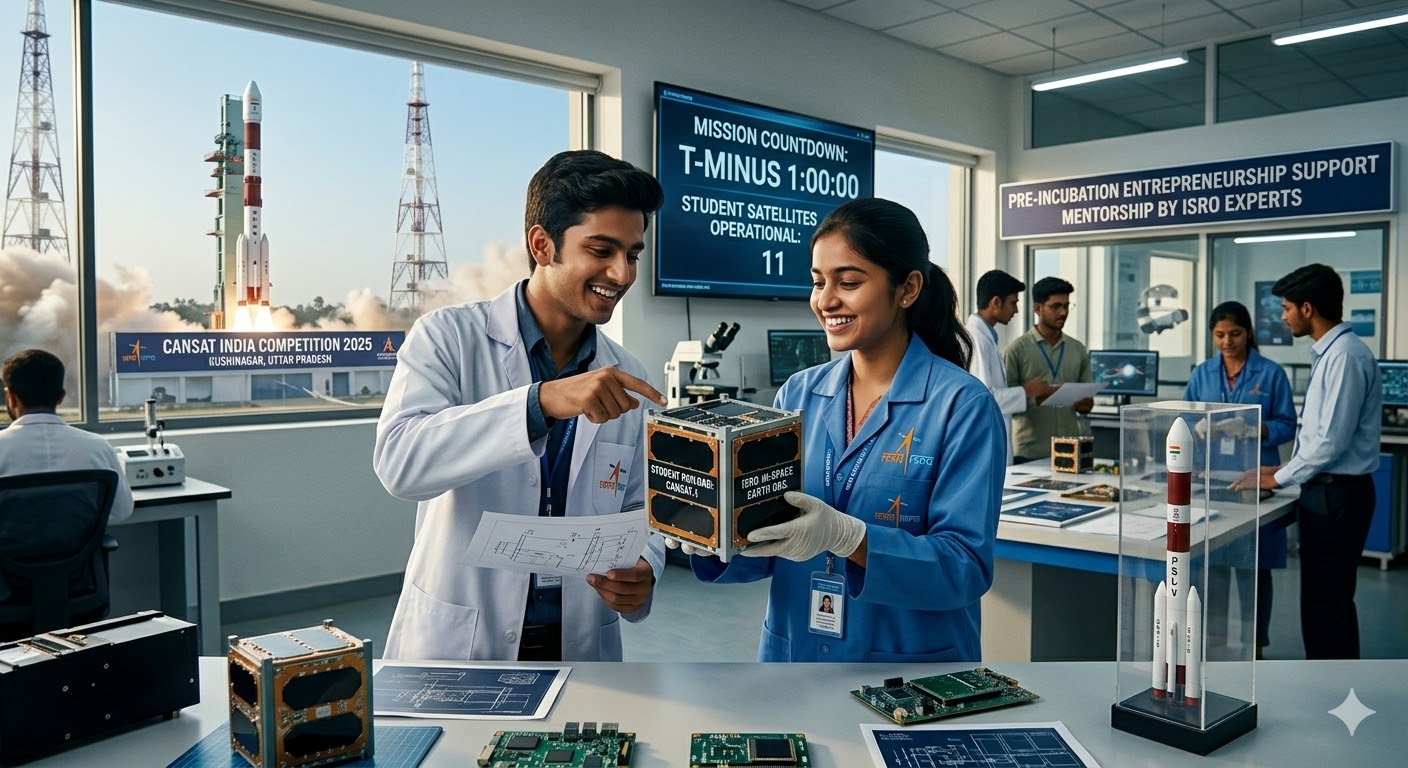
ISRO Student Satellite Programme 2026: In a major boost to India’s space ecosystem, the Government has announced significant progress in involving young minds in space exploration. Under various ISRO and IN-SPACe initiatives, students are now designing, building, and launching their own satellites into orbit. This move marks a transformative shift from classroom learning to real-world space technology application for Indian researchers.
Quick Overview of ISRO Student Satellite Programme 2026
| Feature | Details |
| Scheme Name | ISRO Student Satellite & IN-SPACe Participation |
| Launched By | Department of Space / ISRO |
| Date of Update | March 12, 2026 |
| Category | Science, Technology, and Education |
| Official Website | isro.gov.in / inspace.gov.in |
Key Highlights: ISRO’s Push for Student Involvement
The Union Minister of State for Space, Dr. Jitendra Singh, recently highlighted the success of India’s student-led space missions in the Rajya Sabha. Here are the major takeaways:
- 11 Successful Launches: Out of 17 authorized student satellites and payloads, 11 have already been successfully launched into space.
- Massive Participation: Approximately 850 students from 97 teams across India have participated in satellite and rocket design competitions.
- End-to-End Mentorship: ISRO provides technical guidance, payload development support, and free launch opportunities for selected student projects.
- Regional Accessibility: Through Regional Academic Centres for Space (RAC-S), even students from small towns can now access ISRO’s advanced research facilities.
- Space Education Reform: AICTE has officially approved a Space Technology minor course, integrating space science into the mainstream engineering curriculum.
Who Can Benefit? Key Features of the Program
The Department of Space has structured several pathways for students and entrepreneurs to enter the space sector:
- Academic Institutions: Universities and colleges can partner with the U R Rao Satellite Centre to design and build nano-satellites.
- Young Researchers: Undergraduate and PhD students can avail themselves of Internship and Project Trainee Schemes at various ISRO centers.
- Startups & Entrepreneurs: IN-SPACe offers Pre-incubation support, mentorship from resident experts, and co-working spaces at Technical Centres.
- Innovators: The RESPOND Programme provides financial and technical support for R&D in space science and technology.
How to Participate: Step-by-Step Guide
If you are a student or represent an educational institution interested in building a satellite, follow these steps:
- Form a Team: Gather a multidisciplinary team of students and faculty mentors.
- Register with IN-SPACe: Visit the official IN-SPACe digital platform and register your institution.
- Submit Proposal: Submit a detailed proposal for a student satellite or payload under the Student Satellite Programme.
- Technical Review: ISRO/IN-SPACe experts will review the design for safety and mission feasibility.
- Development & Launch: Upon approval, receive technical mentoring to build your satellite, followed by integration and launch through ISRO’s PSLV/SSLV missions.
The Pivotal Role of IN-SPACe
The Indian National Space Promotion and Authorization Centre (IN-SPACe) acts as the “Single Window” for the private and academic sectors.
- Crucial Role: IN-SPACe is central to authorizing student projects, providing security clearances, and granting access to ISRO’s world-class infrastructure.
- Current Success: 17 projects authorized; 11 successfully launched. This support benefits student teams, startups, and academic bodies.
Model Rocketry & CanSat India 2025 (Kushinagar Finale)
In a historic move to test the “flight-readiness” of student innovations, the Model Rocketry & CanSat India Student Competition reached its grand finale in October 2025 at Kushinagar, Uttar Pradesh. This high-octane event was jointly organized by IN-SPACe, ISRO, and the Astronautical Society of India (ASI).
The competition saw participation from 67 teams comprising over 500 students from top-tier universities across India. These young engineers didn’t just study blueprints—they designed, fabricated, and launched model rockets carrying CanSat payloads (miniature 1 kg satellites) to an altitude of 1 km. This hands-on challenge provides a vital bridge from classroom learning to actual mission execution.
Support for “Space-Preneurs”: Turning Students into CEOs
Beyond the launchpad, the Government is actively nurturing the next generation of space entrepreneurs. In a written reply to the Rajya Sabha on March 12, 2026, Union Minister Dr. Jitendra Singh highlighted three pivotal support pillars managed by IN-SPACe:
- Direct Mentorship: Students get 1-on-1 guidance from resident ISRO experts to refine their technology.
- Pre-Incubation Support: A structured program designed for entrepreneurship development, helping students turn prototypes into products.
- Co-working Spaces: Startups can utilize modern facilities at IN-SPACe Technical Centres, significantly reducing the initial cost of R&D.
Frequently Asked Questions (FAQs)
Q1: How many student satellites have been launched by ISRO so far?
As of March 2026, 11 student-built satellites and payloads have been successfully launched out of the 17 authorized projects.
Q2: Is there any financial support for students to build satellites?
Yes, ISRO provides financial and technical support through the RESPOND Programme and the Space Technology Incubation Centres (STIC) located across various regions.
Q3: Can individual students apply for ISRO internships?
Yes, undergraduate, postgraduate, and doctoral students from recognized institutions can apply for hands-on research experience through ISRO’s official internship schemes.
Q4: What is the role of IN-SPACe in student missions?
IN-SPACe acts as a facilitator, authorizing student satellites, organizing design competitions, and providing mentorship to young space entrepreneurs and students.
Conclusion
The involvement of student researchers in ISRO missions is a cornerstone of the Indian Space Policy 2023. By providing a platform for young innovators to launch satellites like Aazadisat and RVSAT-1, the government is ensuring that India remains a global leader in the New Space age.
(Source: Based on official releases from the Press Information Bureau (PIB).)