
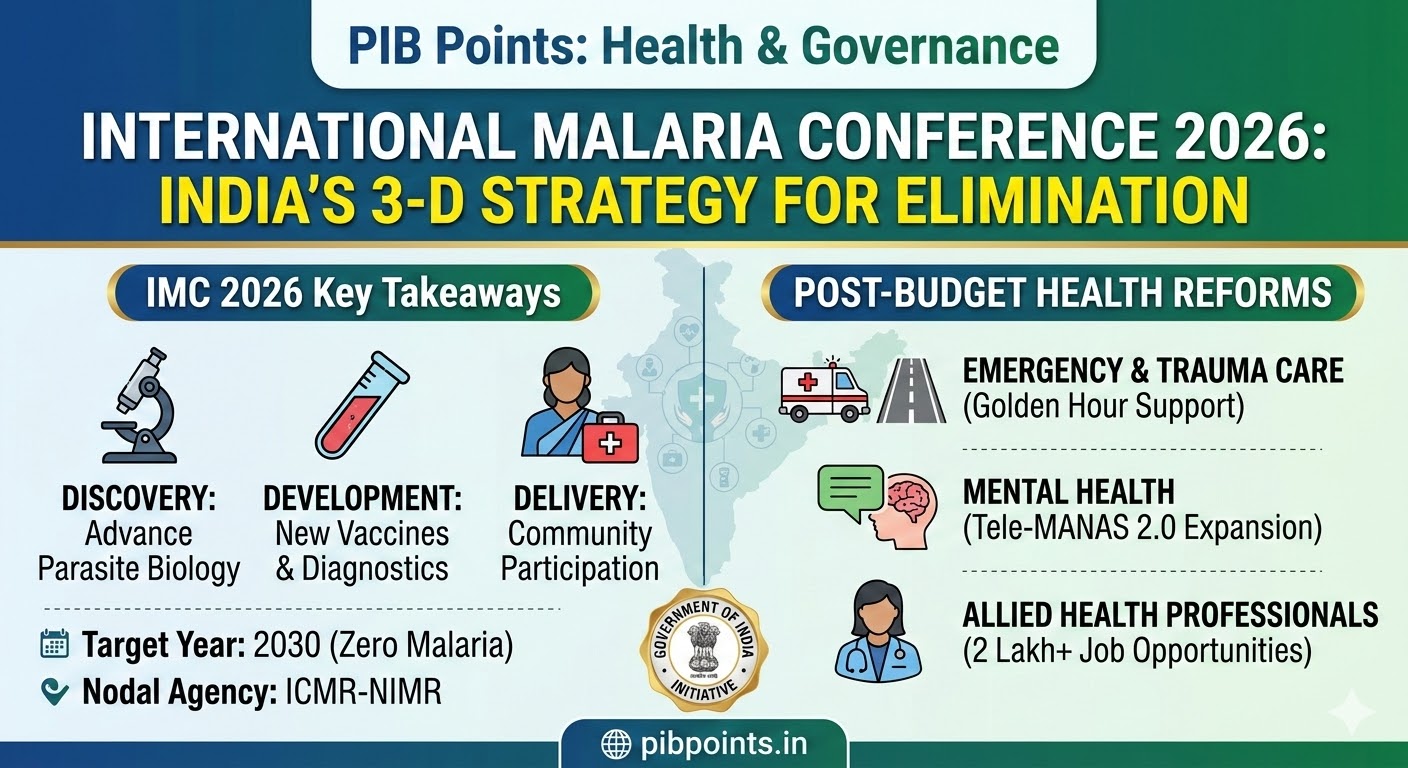
The Government of India has taken a major step toward health security with the conclusion of the International Malaria Conference 2026 and strategic post-budget webinars. This initiative aims to eliminate malaria through innovation and strengthen the national healthcare infrastructure for every citizen.
Quick Overview Table
| Feature | Details |
| Conference Name | International Malaria Conference (IMC) 2026 |
| Organized By | ICMR–National Institute of Malaria Research (NIMR) |
| Release Date | March 9, 2026 |
| Category | Government Health Schemes & Initiatives |
| Official Website | pib.gov.in |
🧬 International Malaria Conference 2026: The 3-D Strategy
The three-day summit held in New Delhi brought together global scientists to tackle Vector-Borne Diseases. The conference was structured around three functional pillars:
- Discovery: Deep-diving into parasite biology and molecular mechanisms to understand drug resistance.
- Development: Creating next-generation vaccines and highly sensitive diagnostic kits.
- Delivery: Strengthening the National Centre for Vector Borne Diseases Control (NCVBDC) to ensure these innovations reach rural and tribal belts.
Key Takeaways for Aspirants:
- Global Synergy: Emphasis on cross-border data sharing to track malaria migration.
- Early-Career Opportunities: ICMR announced new fellowships for researchers specializing in entomology and molecular biology.
- Community Participation: Moving from “Government-led” to “People-led” elimination through ASHAs and local health workers.
🏥 Post-Budget 2026: Strengthening National Health Infrastructure
Following the Union Budget 2026, the government is conducting webinars to simplify complex policy shifts. Three sectors are receiving massive capital infusion:
1. The “Golden Hour” Initiative (Trauma Care)
- Highway Network: Massive investment in trauma centers located every 50-100 km on National Highways.
- Objective: Reducing mortality in road accidents by providing specialized care within the first hour.
2. Tele-MANAS 2.0 (Mental Health)
- Expansion of district-level mental wellness clinics.
- Integration of AI-driven counseling via the Tele-MANAS helpline to tackle rising urban stress and student anxiety.
3. Allied Health Professionals (AHP) Framework
- New certification standards for paramedics, lab technicians, and physiotherapists.
- Job Growth: This framework is expected to create over 2 lakh jobs in the organized health sector by 2027.
✍️ Exam-Point: Why This Matters for Your Preparation
If you are appearing for UPSC GS Paper II (Health & Governance) or SSC CGL (General Awareness), keep these points in your short notes:
- Target Year: India is committed to eliminating malaria by 2030, with a goal to be “malaria-free” (zero indigenous cases) by 2027.
- Sustainable Development Goals (SDG): This initiative directly contributes to SDG 3.3 (Ending epidemics of tropical diseases).
- Technical Terms: Be familiar with Vector Control, Molecular Surveillance, and Genomic Sequencing in the context of malaria.
❓ Frequently Asked Questions (FAQs)
Q1. What is the difference between Malaria ‘Elimination’ and ‘Eradication’? Elimination refers to stopping local transmission in a specific geographic area (India’s goal for 2030), while Eradication refers to the permanent global reduction to zero of the disease (like Smallpox).
Q2. Which organization monitors malaria at the national level? The National Centre for Vector Borne Diseases Control (NCVBDC), under the Directorate General of Health Services (DGHS).
Q3. How can I access the Post-Budget health webinars? Recordings and summaries are available on the official MoHFW YouTube channel and the PIB website under the “Webinars” section.
Final Thoughts
The IMC 2026 is not just a scientific meeting; it is a roadmap for a healthier India. As the “Pharmacy of the World,” India’s success in malaria elimination will serve as a blueprint for the Global South.
Stay tuned to pibpoints.in for more simplified government updates!