
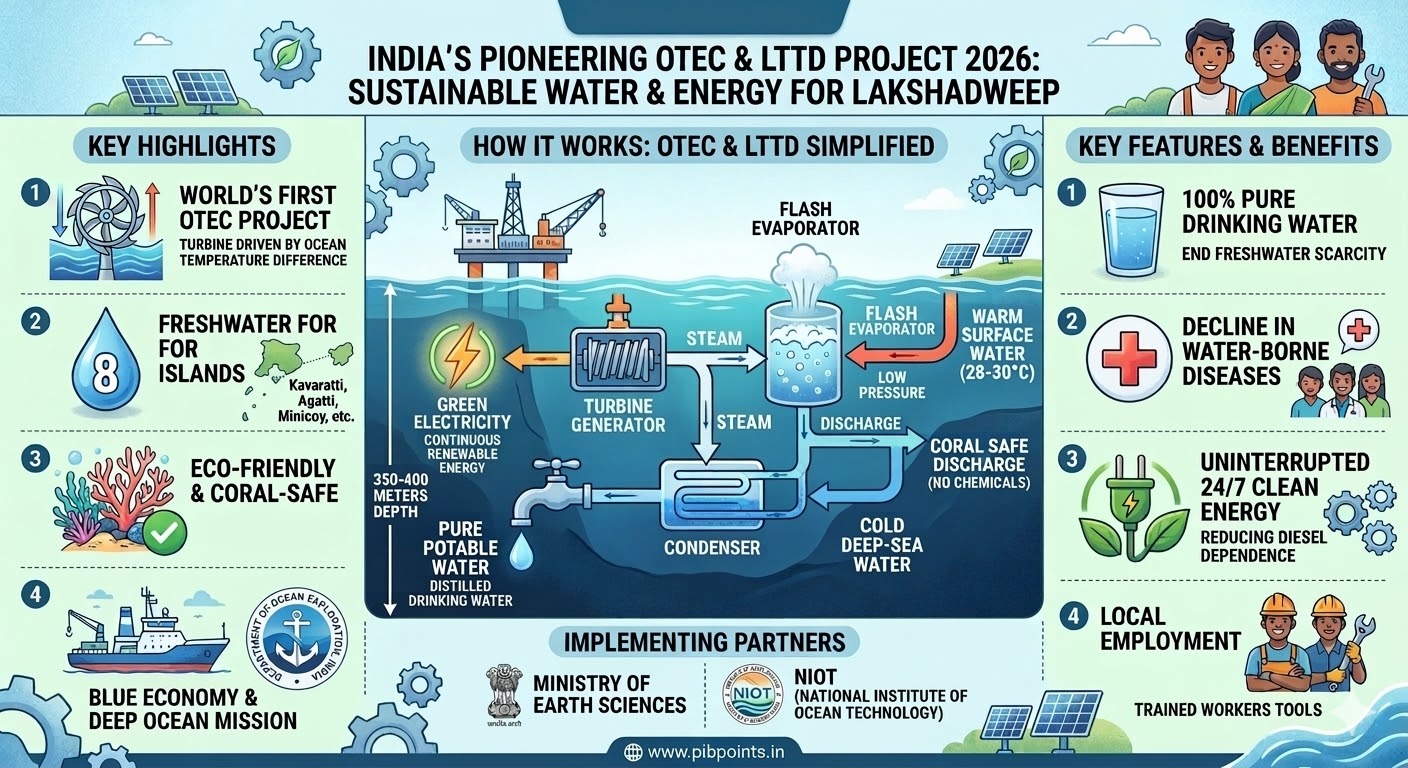
The Government of India has achieved a major milestone in renewable energy and water security. Union Minister Dr. Jitendra Singh recently reviewed the Ocean Thermal Energy Conversion (OTEC) and Low Temperature Thermal Desalination (LTTD) projects in Lakshadweep. These innovative technologies are set to provide continuous drinking water and clean energy to island citizens, ending years of freshwater scarcity.
Quick Overview: Lakshadweep Ocean Energy & Water Project
| Project Feature | Details |
| Project Name | OTEC & LTTD Desalination Plants |
| Launched By | Ministry of Earth Sciences (MoES) |
| Implementation Agency | National Institute of Ocean Technology (NIOT) |
| Review Date | March 6, 2026 |
| Primary Location | Kavaratti & 8 other islands, Lakshadweep |
| Official Website | moes.gov.in |
Key Highlights of the OTEC & LTTD Projects
The visit by the Union Minister highlights India’s global leadership in deep-ocean technology. Here are the major takeaways from the official press release:
- World’s First OTEC Project: India is pioneering the Ocean Thermal Energy Conversion project in Lakshadweep, which generates electricity using the temperature difference between warm surface water and cold deep-sea water.
- Freshwater for 8 Islands: Currently, LTTD plants are operational in Kavaratti, Agatti, Minicoy, Amini, Kalpeni, Kadamat, Chetlat, and Kiltan.
- Eco-Friendly Technology: Unlike traditional methods, this process uses no chemical additives and avoids discharging harmful brine, protecting the fragile coral ecosystems.
- Blue Economy Focus: This initiative is a core part of India’s Deep Ocean Mission, aimed at making island territories self-reliant in energy and water.
Who Will Benefit? (Key Features)
The deployment of these technologies is a game-changer for the residents of the Lakshadweep archipelago:
- Local Residents: Overcoming the “salinity intrusion” in groundwater, residents now have access to 100% pure potable water.
- Health Benefits: There has been a significant decline in water-borne diseases across the islands since the implementation of LTTD.
- Uninterrupted Energy: Unlike solar or wind, OTEC provides a continuous 24/7 energy source, reducing the reliance on expensive and polluting diesel generators.
- Employment: The plants are operated with the support of trained local personnel, creating technical jobs within the community.
How Does Ocean Thermal Technology Work?
For those wondering how seawater turns into drinking water and energy, here is the simplified process:
- Water Intake: Warm surface water (approx. 28-30°C) is drawn from the ocean surface.
- Flash Evaporation: This water is evaporated under low pressure to create steam.
- Deep-Sea Cooling: Cold water is pumped from depths of 350 to 400 meters to condense the steam.
- Output: This condensation results in pure distilled water, while the temperature gradient drives turbines to generate green electricity.
Conclusion
The successful scaling of OTEC and LTTD technologies in Lakshadweep marks a new era for India’s Viksit Bharat vision. By turning the vast ocean into a resource for survival and power, the government is ensuring that even the most remote citizens have access to basic necessities through sustainable science.
Read Also: Micron Sanand Facility Inauguration: India’s Giant Leap in Semiconductor Manufacturing
Frequently Asked Questions (FAQs)
1. What is the full form of OTEC and LTTD?
OTEC stands for Ocean Thermal Energy Conversion, and LTTD stands for Low Temperature Thermal Desalination.
2. Which islands in Lakshadweep have these water plants?
Plants are currently operational in 8 islands: Kavaratti, Agatti, Minicoy, Amini, Kalpeni, Kadamat, Chetlat, and Kiltan.
3. Is the water produced by these plants safe for drinking?
Yes, the LTTD process produces high-quality potable water that meets safety standards without the use of harmful chemicals.
4. Why is OTEC better than solar energy for islands?
While solar energy depends on sunlight, OTEC provides a constant, uninterrupted supply of power regardless of weather conditions or time of day.