
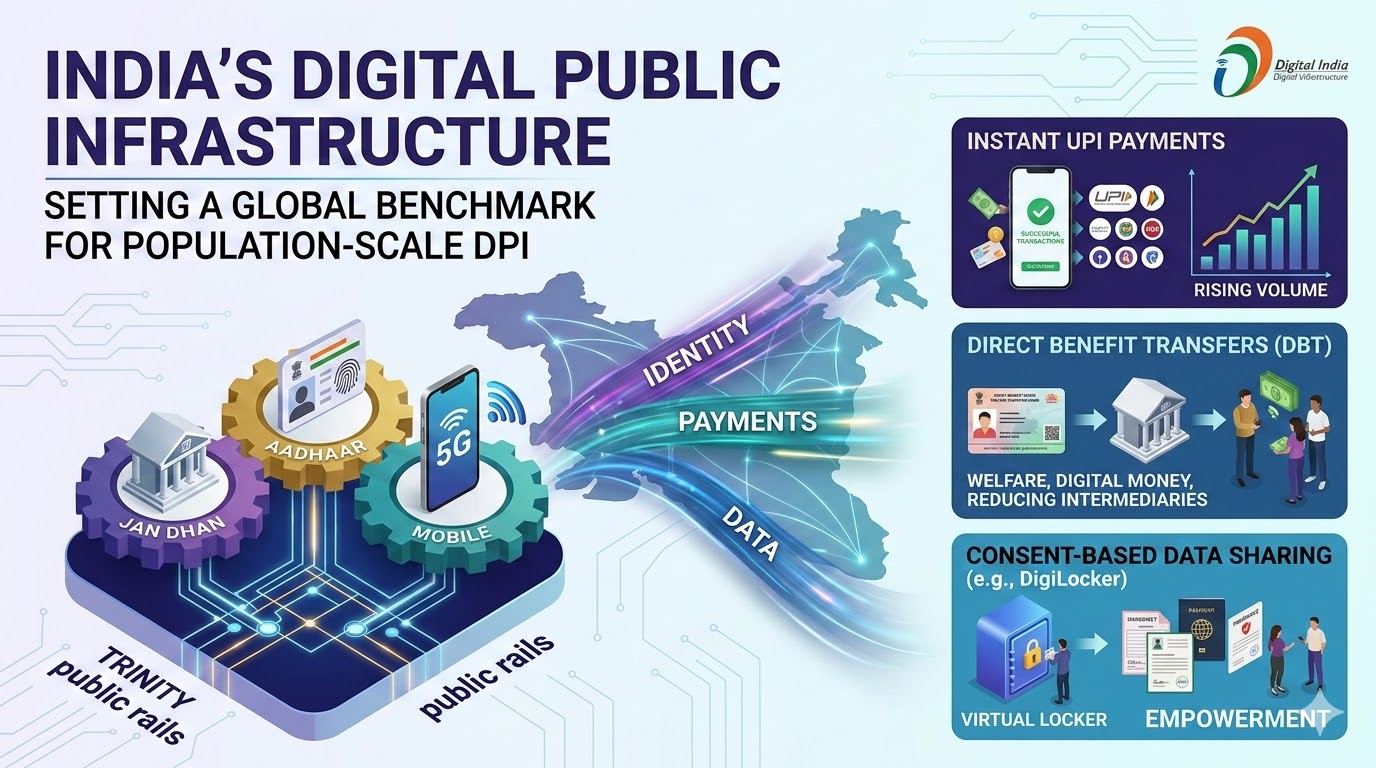
India has officially set a global benchmark in the digital world. The latest report on Digital Public Infrastructure (DPI) reveals how the “India Stack” is transforming the lives of 144 crore citizens by making governance, payments, and document access seamless and paperless.
Quick Overview: India’s Digital Transformation
| Detail | Information |
| Scheme/Initiative | India’s Digital Public Infrastructure (DPI) |
| Launched By | Government of India |
| Report Date | March 6, 2026 |
| Category | Digital Governance & Financial Inclusion |
| Official Website | pib.gov.in / india.gov.in |
Key Highlights of India’s DPI Success
The “India Stack” is built on three main pillars: Identity (Aadhaar), Payments (UPI), and Data Exchange (DigiLocker). Here are the major breakthroughs:
- Aadhaar Milestone: Over 144 crore Aadhaar numbers have been generated as of March 2026, making it the world’s largest biometric ID system.
- UPI Dominance: In January 2026 alone, UPI processed 21.70 billion transactions worth ₹28.33 lakh crore.
- Financial Inclusion: Under PM Jan Dhan Yojana, bank accounts have grown to 57.71 crore, with total deposits crossing ₹2.94 lakh crore.
- 5G Revolution: 5G services are now available in 99.9% of Indian districts, ensuring high-speed connectivity for rural areas.
- Paperless Governance: DigiLocker now has over 67.63 crore users, with 950 crore digital documents issued so far.
Key Features & Benefits to Citizens
The DPI ecosystem is designed to empower the common man by removing middlemen and reducing corruption.
- Direct Benefit Transfer (DBT): Welfare benefits now move directly into bank accounts. The government has saved over ₹4.31 lakh crore by eliminating leakages.
- Universal Access: With UMANG App, citizens can access over 2,400 government services (EPFO, PAN, Passport, etc.) from a single window.
- Digital Commerce (ONDC): Small sellers from over 630 cities are now live on the Open Network for Digital Commerce, allowing them to compete with big e-commerce giants.
- e-Courts: Judicial processes are becoming faster and more transparent through digital filing and online payments.
How to Access Digital Services in India (Step-by-Step)
If you want to take advantage of India’s digital infrastructure, follow these simple steps:
- For Digital Documents: Download the DigiLocker App from Play Store/App Store. Link your Aadhaar to fetch your Driving License, Marksheets, and Insurance papers digitally.
- For Government Services: Install the UMANG App. Register with your mobile number to check your PF balance, apply for a PAN card, or track your scholarship.
- For Secure Payments: Use any UPI-enabled app (like BHIM, Google Pay, or PhonePe). Ensure your mobile number is linked to your Jan Dhan or Savings account for instant transfers.
- For Small Businesses: If you are a seller, register on the ONDC network or GeM (Government e-Marketplace) to sell products directly to government departments and a wider audience.
Conclusion
India’s journey from being a digital user to a digital architect is a lesson for the world. By combining the JAM Trinity (Jan Dhan-Aadhaar-Mobile), the country has ensured that even the most remote citizen is connected to the formal economy. This digital backbone is not just about technology; it’s about transparency, speed, and empowerment.
Frequently Asked Questions (FAQs)
Q1: What is the JAM Trinity in India?
The JAM Trinity stands for Jan Dhan (Bank Accounts), Aadhaar (Digital Identity), and Mobile (Connectivity). It forms the foundation of India’s digital welfare delivery system.
Q2: How many people use DigiLocker in India?
As of March 2026, more than 67.63 crore citizens are using DigiLocker to store and share their documents securely.
Q3: Is UPI used outside India?
Yes, India’s UPI is being recognized globally. Several countries in the Global South and nations like the UAE, Singapore, and France have shown interest or started adopting UPI-based payment systems.
Q4: How does DPI help in reducing corruption?
DPI enables Direct Benefit Transfer (DBT), which sends money directly to the beneficiary’s bank account, bypasses intermediaries, and uses Aadhaar for verification to remove “ghost” or fake beneficiaries.India has officially set a global benchmark in the digital world. The latest report on Digital Public Infrastructure (DPI) reveals how the “India Stack” is transforming the lives of 144 crore citizens by making governance, payments, and document access seamless and paperless.
Quick Overview: India’s Digital Transformation
| Detail | Information |
| Scheme/Initiative | India’s Digital Public Infrastructure (DPI) |
| Launched By | Government of India |
| Report Date | March 6, 2026 |
| Category | Digital Governance & Financial Inclusion |
| Official Website | pib.gov.in / india.gov.in |
Key Highlights of India’s DPI Success
The “India Stack” is built on three main pillars: Identity (Aadhaar), Payments (UPI), and Data Exchange (DigiLocker). Here are the major breakthroughs:
- Aadhaar Milestone: Over 144 crore Aadhaar numbers have been generated as of March 2026, making it the world’s largest biometric ID system.
- UPI Dominance: In January 2026 alone, UPI processed 21.70 billion transactions worth ₹28.33 lakh crore.
- Financial Inclusion: Under PM Jan Dhan Yojana, bank accounts have grown to 57.71 crore, with total deposits crossing ₹2.94 lakh crore.
- 5G Revolution: 5G services are now available in 99.9% of Indian districts, ensuring high-speed connectivity for rural areas.
- Paperless Governance: DigiLocker now has over 67.63 crore users, with 950 crore digital documents issued so far.
Key Features & Benefits to Citizens
The DPI ecosystem is designed to empower the common man by removing middlemen and reducing corruption.
- Direct Benefit Transfer (DBT): Welfare benefits now move directly into bank accounts. The government has saved over ₹4.31 lakh crore by eliminating leakages.
- Universal Access: With UMANG App, citizens can access over 2,400 government services (EPFO, PAN, Passport, etc.) from a single window.
- Digital Commerce (ONDC): Small sellers from over 630 cities are now live on the Open Network for Digital Commerce, allowing them to compete with big e-commerce giants.
- e-Courts: Judicial processes are becoming faster and more transparent through digital filing and online payments.
Beyond identity and payments, India is now breaking language barriers in governance. With the launch of Voicera: India’s New Open-Source Voice AI, citizens can now interact with government digital platforms using their local dialects, making DPI truly inclusive for all.
How to Access Digital Services in India (Step-by-Step)
If you want to take advantage of India’s digital infrastructure, follow these simple steps:
- For Digital Documents: Download the DigiLocker App from Play Store/App Store. Link your Aadhaar to fetch your Driving License, Marksheets, and Insurance papers digitally.
- For Government Services: Install the UMANG App. Register with your mobile number to check your PF balance, apply for a PAN card, or track your scholarship.
- For Secure Payments: Use any UPI-enabled app (like BHIM, Google Pay, or PhonePe). Ensure your mobile number is linked to your Jan Dhan or Savings account for instant transfers.
- For Small Businesses: If you are a seller, register on the ONDC network or GeM (Government e-Marketplace) to sell products directly to government departments and a wider audience.
Conclusion
India’s journey from being a digital user to a digital architect is a lesson for the world. By combining the JAM Trinity (Jan Dhan-Aadhaar-Mobile), the country has ensured that even the most remote citizen is connected to the formal economy. This digital backbone is not just about technology; it’s about transparency, speed, and empowerment.
Frequently Asked Questions (FAQs)
Q1: What is the JAM Trinity in India?
The JAM Trinity stands for Jan Dhan (Bank Accounts), Aadhaar (Digital Identity), and Mobile (Connectivity). It forms the foundation of India’s digital welfare delivery system.
Q2: How many people use DigiLocker in India?
As of March 2026, more than 67.63 crore citizens are using DigiLocker to store and share their documents securely.
Q3: Is UPI used outside India?
Yes, India’s UPI is being recognized globally. Several countries in the Global South and nations like the UAE, Singapore, and France have shown interest or started adopting UPI-based payment systems.
Q4: How does DPI help in reducing corruption?
DPI enables Direct Benefit Transfer (DBT), which sends money directly to the beneficiary’s bank account, bypasses intermediaries, and uses Aadhaar for verification to remove “ghost” or fake beneficiaries.
[…] on this telecommunications foundation, explore how India’s Digital Public Infrastructure (DPI) is leveraging this connectivity to power a seamless, inclusive digital economy in […]