
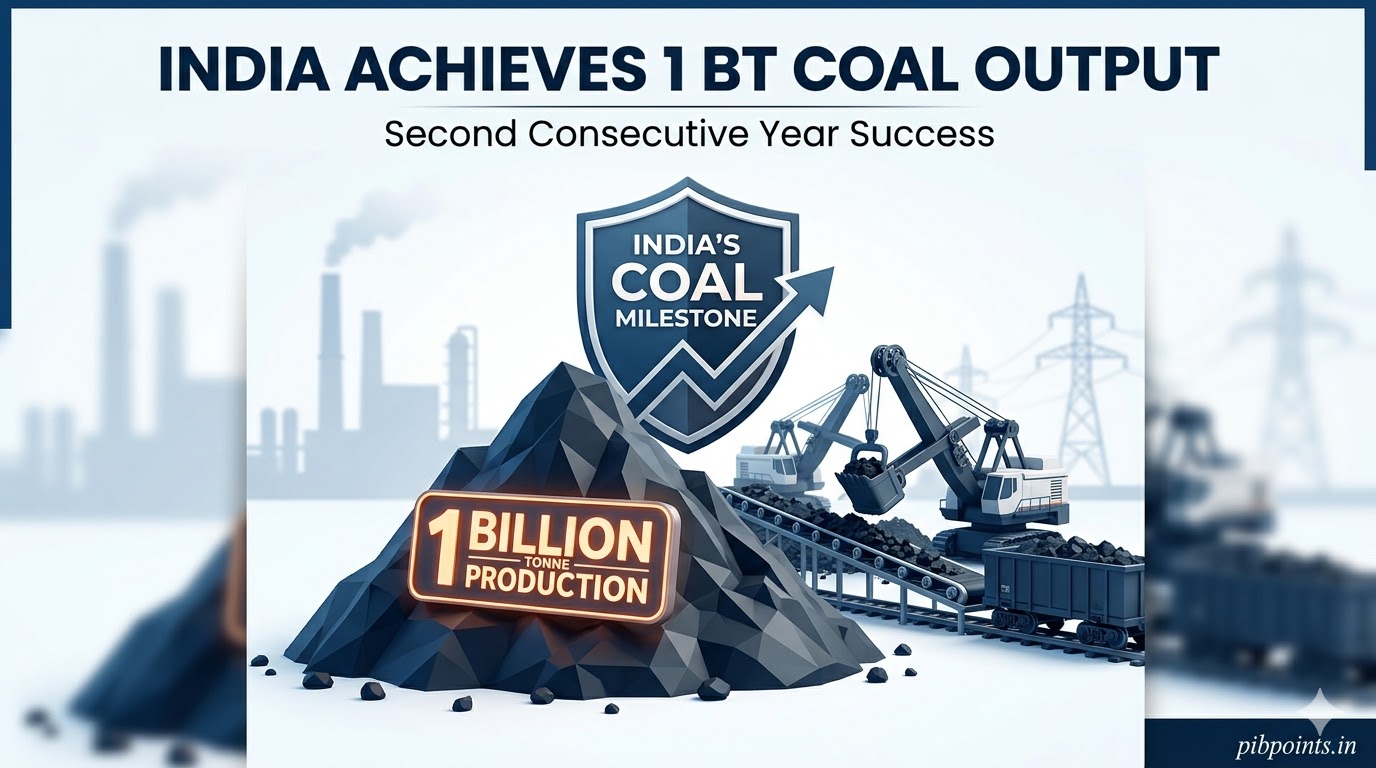
In the global narrative of the green energy transition, India has sent a powerful message of pragmatic growth. On March 20, 2026, the Ministry of Coal announced that the country successfully achieved the landmark of 1 Billion Tonne (BT) coal production for the second consecutive year.
India’s 1 Billion Tonne Coal Milestone
This achievement isn’t just a spreadsheet entry; it is the heartbeat of an economy refusing to slow down. While global markets watch India’s record-breaking solar auctions, this coal milestone provides the foundational “baseload” power that ensures the national grid remains stable while renewable infrastructure scales up.
Data Analysis: India’s Production Trend (2021-2026)
Not long ago, the Indian power sector faced frequent “coal shortages,” leading to erratic power cuts and a heavy reliance on expensive imports from Indonesia and Australia. Strategic policy shifts in mineral governance have since transformed this scarcity into surplus.
India’s Coal Production Growth Table
| Fiscal Year | Production (Million Tonnes) | Key Growth Drivers |
| 2021-22 | 778 MT | Post-pandemic industrial recovery. |
| 2022-23 | 893 MT | Push for commercial mining auctions. |
| 2023-24 | 997 MT | Scaling of mega-mines (e.g., Gevra & Kusmunda). |
| 2024-25 | 1,000+ MT | First historic 1 BT Milestone. |
| 2025-26 | 1,000+ MT | Sustained success & import substitution. |
Analyst Note: Strategic initiatives like “Mission 1.2 Billion Tonne” drove this sustained performance. By crossing this threshold again, India has effectively insulated its power sector from volatile global energy price swings.
The Great Balancing Act: Coal vs. Climate Commitments
For UPSC aspirants and policy analysts, the “Coal vs. Climate” debate is a central theme. How does India justify a billion tonnes of coal while championing the International Solar Alliance and Panchamrit goals?
- The Intermittency Challenge: India’s energy demand grows at 7-8% annually. Since solar and wind are intermittent (not available 24/7), coal provides the necessary Grid Resilience.
- From “Phase Out” to “Phase Down”: At COP26, India successfully navigated the shift toward a “Phase Down” strategy. Affordable energy remains non-negotiable for poverty alleviation and the Make in India manufacturing push.
- Reducing Import Dependency: Moving toward Atmanirbharta (Self-reliance) saves billions in foreign exchange, strengthening the Indian Rupee against global fluctuations.
Greening the Black Diamond: Innovation in Mining
The Ministry of Coal is shifting from “volume” to “value.” Two critical pillars are redefining the sector’s environmental footprint:
1. Coal Gasification (Target: 100 MT by 2030)
The government is incentivizing the conversion of coal into syngas. This can be used to produce chemicals and fertilizers, significantly reducing the direct carbon footprint compared to traditional thermal burning.
2. First Mile Connectivity (FMC)
To reduce pollution from truck transport, the Ministry has invested in mechanized coal handling plants and railway sidings directly at pitheads. This ensures Evacuation Efficiency, moving coal from mine to power plant with minimal environmental leakage.
Energy Sovereignty and Viksit Bharat 2047
Under the vision of Viksit Bharat 2047, India aims to be a developed nation by the centenary of its independence. Energy sovereignty—the ability to power our own industries without external reliance—is the first pillar of that vision.
Quick Bite: Summary for Revision
- What: India achieved 1 Billion Tonne coal production.
- When: March 20, 2026 (Second consecutive year).
- Impact: Record-high stocks at thermal power plants (TPPs).
- Strategic Goal: Aligned with Energy Security and Panchamrit targets.
Frequently Asked Questions (FAQs)
Q1: Does this mean India is giving up on its Renewable Energy targets?
No. India remains on track to reach 500 GW of non-fossil fuel capacity. Coal acts as a “bridge fuel” to ensure economic stability during this massive infrastructure transition.
Q2: What is the significance of the 1 Billion Tonne mark for the common man?
It translates to Energy Security. For consumers, it means fewer power cuts during peak summer months and more stable electricity prices due to reduced vulnerability to global coal price hikes.
Q3: Who are the major contributors to this production?
While Coal India Limited (CIL) is the primary driver, a significant portion of growth now stems from Captive and Commercial blocks, which have increased competition and operational efficiency.
External Link: For the official press release, visit the Ministry of Coal on PIB.gov.in.
Comments are closed.