
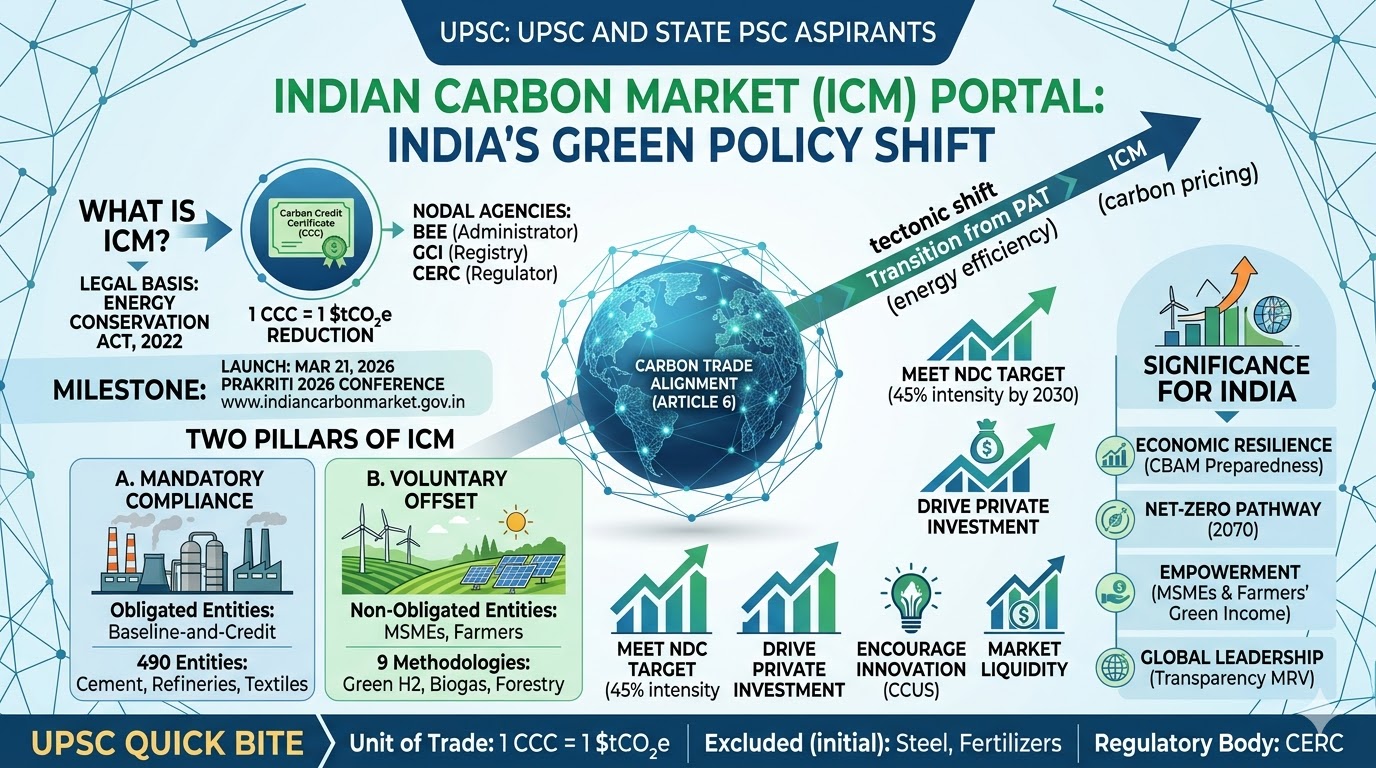
The landscape of India’s climate policy shifted significantly on March 21, 2026, with the official launch of the Indian Carbon Market (ICM) Portal during the Prakriti 2026 conference. This move signals a transition from energy-efficiency schemes like PAT (Perform, Achieve, and Trade) to a sophisticated, market-based carbon pricing mechanism.
For UPSC and State PSC aspirants, the ICM is a “high-yield” topic intersecting Economics, Environment, and International Relations (specifically CBAM and Article 6 of the Paris Agreement).
1. What is the Indian Carbon Market (ICM)?
The ICM is a national framework designed to decarbonize the Indian economy by putting a financial price on carbon emissions. It creates a system where Carbon Credit Certificates (CCCs) are issued to entities that reduce greenhouse gas (GHG) emissions beyond a set target.
- Legal Foundation: Empowered by the Energy Conservation (Amendment) Act, 2022.
- The 2026 Milestone: The Union Power Minister inaugurated the www.indiancarbonmarket.gov.in portal, centralizing all trading and registry activities.
- The Governance Trio:
- Administrator: Bureau of Energy Efficiency (BEE) – Sets targets and identifies sectors.
- Registry Operator: Grid Controller of India Ltd (GCI).
- Market Regulator: Central Electricity Regulatory Commission (CERC).
2. The Two Pillars of ICM: Compliance vs. Offset
The ICM uses a dual-track approach to ensure both mandatory industrial participation and voluntary grassroots involvement.
Comparison of ICM Mechanisms
| Feature | Compliance Mechanism (Mandatory) | Offset Mechanism (Voluntary) |
| Target Audience | “Obligated Entities” (Large Industries) | MSMEs, Farmers, Municipalities |
| System Type | Baseline-and-Credit (Intensity-based) | Project-based (Reduction/Removal) |
| Sectors (2026) | Aluminum, Cement, Textiles, Petrochemicals | Agriculture, Forestry, Green Hydrogen |
| Unit of Trade | 1 CCC = 1 Metric Tonne of $CO_2e$ | 1 CCC = 1 Metric Tonne of $CO_2e$ |
| Primary Goal | Industrial Decarbonization | Grassroots Green Income |
3. Strategic Significance: Why the ICM Matters Now
I. Economic Resilience & CBAM Preparedness
The European Union’s Carbon Border Adjustment Mechanism (CBAM) will soon tax carbon-intensive imports like steel and cement. By establishing a robust domestic market, Indian industries can pay for carbon locally, potentially offsetting the “carbon tax” burden imposed by foreign markets.
II. The Net-Zero 2070 Pathway
India has pledged to reach Net Zero by 2070. The ICM provides the economic “carrot and stick” needed for “hard-to-abate” sectors (Steel, Cement) to invest in Carbon Capture, Utilization, and Storage (CCUS) and Green Hydrogen technologies.
III. Empowerment of the Agri-Sector
Through the Offset Mechanism, a farmer managing a sustainable agro-forestry project or a community running a biogas plant can generate CCCs. This creates a new stream of “Green Income” for rural India.
4. Challenges and the Road Ahead
While the portal launch is a milestone, three hurdles remain:
- Price Volatility: To ensure stability, the government is considering Price Stability Mechanisms (PSM), including price floors and ceilings.
- Verification Integrity: BEE is currently accrediting Carbon Verification Agencies to provide rigorous Monitoring, Reporting, and Verification (MRV) and prevent “Greenwashing.”
- PAT Integration: Merging existing Energy Saving Certificates (ESCerts) into the CCC system is a complex administrative transition currently underway.
Quick Revision “Cheat Sheet”
- Portal: www.indiancarbonmarket.gov.in (Launched March 2026).
- Nodal Oversight: Co-chaired by the National Steering Committee (Power & Environment Ministries).
- Phase 2 Expansion: Petroleum Refineries and Textiles were notified in January 2026.
- Trading Cycle: First compliance cycle ends March 2026; credit issuance begins October 2026.
Comparison: Indian Carbon Market (ICM) vs. EU Emissions Trading System (ETS)
| Feature | Indian Carbon Market (ICM) | EU Emissions Trading System (ETS) |
| System Type | Baseline-and-Credit: Targets are set on emission intensity (emissions per unit of GDP/production). Allows production growth if efficiency improves. | Cap-and-Trade: A strict absolute cap is set on total emissions. The cap decreases annually. |
| Market Maturity | Emergent/Developing. Focused on aligning with domestic development goals (NDC). | Highly Mature (Operational since 2005). The global benchmark for carbon markets. |
| Sectoral Approach | Phased implementation. Phase 1 (Aluminum, Cement, etc.); Phase 2 (Textiles, Refineries). | Comprehensive coverage including power, industry, aviation, and maritime transport. |
| Global Alignment | Designed to prevent fragmentation and prepare for CBAM (Carbon Border Adjustment Mechanism). Future link to Article 6. | The basis for implementing CBAM, requiring importers to pay for carbon matching the EU ETS price. |
| Strategic Focus | Balancing industrial growth with decarbonization (“Growth with Green”). | Achieving deep, absolute emission cuts to meet Net Zero goals (“Deep Decarbonization”). |
FAQ: Frequently Asked Questions
Q1: What is the main difference between the PAT scheme and the ICM?
The PAT scheme focused strictly on Energy Efficiency (saving fuel/electricity). The ICM focuses directly on GHG Emission Reduction. PAT issued ESCerts; the ICM issues Carbon Credit Certificates (CCCs).
Q2: Can individuals earn from the Indian Carbon Market?
Indirectly. By participating in “Offset Projects” (like waste management or solar pumps), individuals or cooperatives can generate credits to be sold on the national exchange.
Q3: Is the ICM linked to international markets?
Currently, it is a domestic market. However, it is designed to eventually align with Article 6.4 of the Paris Agreement, allowing for global carbon trading in the future.
Expert Note: For official technical specifications and the full list of the 490 obligated entities, refer to the Ministry of Power via PIB Release ID: 2243377.
Comments are closed.