
Ministry: Agriculture & Farmers Welfare / Finance | Date: 17 March 2026 | Source: PIB Delhi
Introduction
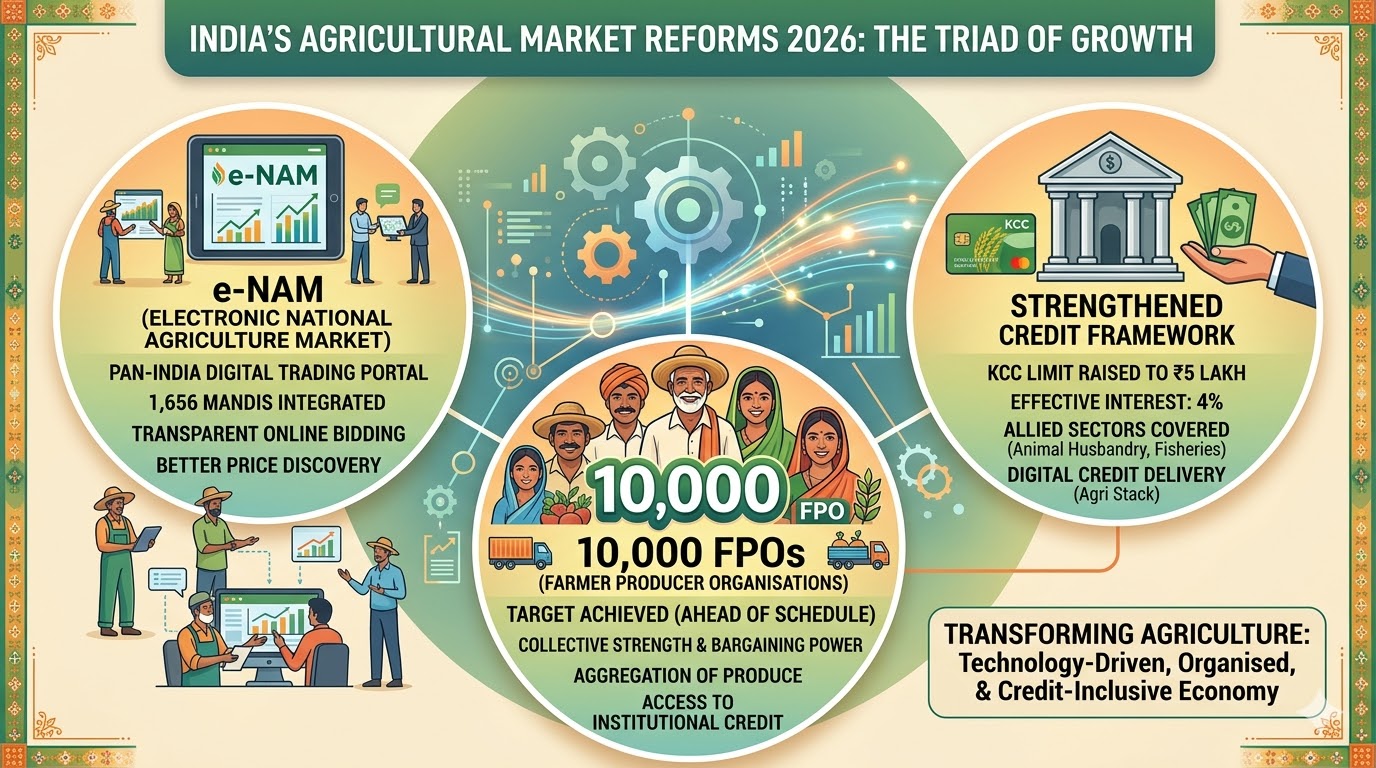
Three landmark PIB releases on 17 March 2026 collectively paint a comprehensive picture of India’s agricultural market reforms: the growth of e-NAM (Electronic National Agriculture Market), the milestone of 10,000 Farmer Producer Organisations (FPOs), and the government’s strengthened institutional credit framework for agriculture. Together, these reforms mark a decisive shift toward a technology-driven, organised, and credit-inclusive agricultural economy.
Part 1: e-NAM — Electronic National Agriculture Market
Key Data Points (2026)
| Mandis Integrated | 1,656 mandis across India |
| Farmers Benefited | Over 1.80 crore farmers |
| Total Trade Value | ₹4.82 lakh crore since inception |
| Launch Year | 2016 |
| Nodal Agency | Small Farmers Agribusiness Consortium (SFAC) |
| Ministry | Agriculture & Farmers Welfare |
What is e-NAM?
e-NAM is a pan-India electronic trading portal that networks existing APMC (Agricultural Produce Market Committee) mandis to create a unified national market for agricultural commodities. It enables farmers to get better prices through transparent, competitive, online bidding and reduces their dependence on local middlemen.
Key Features of e-NAM
- Online trading platform connecting farmers, traders, and buyers across state boundaries
- Quality assaying at mandis before trade ensures transparency
- Direct payment into farmers’ bank accounts via DBT
- Mobile app available in multiple regional languages
- Integration with FPOs and warehouses for logistics efficiency
Part 2: 10,000 FPOs — Farmer Producer Organisations Milestone
| Total FPOs Registered | 10,000 (milestone achieved) |
| Target (original) | 10,000 FPOs by 2027-28 |
| Achievement | Target achieved ahead of schedule |
| Scheme | Formation and Promotion of 10,000 FPOs (Central Sector Scheme) |
| Outlay | ₹6,865 crore (2020-2027) |
| Support per FPO | Up to ₹18 lakh over 3 years |
What are FPOs?
Farmer Producer Organisations are collectives of farmers (like cooperatives) registered as companies under the Companies Act or cooperative laws. They enable small and marginal farmers to aggregate produce, access markets collectively, negotiate better prices, avail institutional credit, and reduce input costs through bulk purchasing.
Benefits of FPOs
- Collective bargaining power for small farmers
- Access to institutional credit and formal markets
- Link with e-NAM for online commodity trading
- Agri-input procurement at reduced costs
- Value addition and processing at cluster level
- Women FPOs for empowerment of women farmers
Part 3: Strengthened Institutional Credit Framework for Agriculture
The government has strengthened the institutional credit architecture for agriculture and allied sectors through multiple measures including enhanced Kisan Credit Card (KCC) limits, priority sector lending norms, and expanded coverage of the Interest Subvention Scheme.
- KCC Limit Enhanced: Credit limit under Kisan Credit Card raised to ₹5 lakh (from ₹3 lakh) for short-term agricultural needs.
- Interest Subvention: 2% subvention + 3% prompt repayment incentive = effective 4% interest for farmers.
- Allied Sectors Covered: Animal husbandry, fisheries, and dairy now covered under institutional agricultural credit.
- Digital Credit: Agri Stack and Digital India integration for paperless, faster credit delivery to farmers.
Interconnection: e-NAM + FPO + Credit = Agriculture Reform Triad
| Reform | Role in Agriculture | Beneficiary |
|---|---|---|
| e-NAM | Market access & price transparency | 1.80 crore+ farmers |
| FPOs (10,000) | Collective strength & aggregation | Small & marginal farmers |
| Credit Framework | Financial inclusion & working capital | All agricultural households |
Quick Revision Box
- e-NAM mandis: 1,656 | Farmers: 1.80 crore+ | Trade: ₹4.82 lakh crore
- FPOs registered: 10,000 (target achieved ahead of schedule)
- FPO scheme outlay: ₹6,865 crore
- KCC enhanced limit: ₹5 lakh
- Effective interest for farmers: 4% p.a.
FAQ: Transforming India’s Agriculture (2026 Reforms)
Q1: What is the significance of reaching the 10,000 FPO milestone ahead of schedule? The achievement of the 10,000 FPO target by early 2026 (originally slated for 2027-28) signals a rapid formalization of the agricultural economy. It means more small and marginal farmers now have collective bargaining power, reduced input costs, and direct access to post-harvest processing, which is critical for doubling farmers’ income.
Q2: How does the enhanced KCC limit benefit allied sectors like fisheries and dairy? By raising the Kisan Credit Card (KCC) limit to ₹5 lakh, the government has provided much-needed liquidity for capital-intensive allied sectors. Previously, these sectors faced credit gaps; now, they can access formal credit at an effective interest rate of 4%, fostering diversification beyond traditional crop farming.
Q3: Can an individual farmer trade directly on e-NAM without a middleman? Yes. e-NAM is designed to eliminate the “Commission Agent” culture. Farmers can upload their produce, have it quality-assayed at the mandi, and receive competitive bids from buyers across India. Payments are settled via Direct Benefit Transfer (DBT) into their linked bank accounts.
Q4: What is the role of the Small Farmers Agribusiness Consortium (SFAC)? SFAC is the nodal agency responsible for the implementation of e-NAM. it leads the integration of mandis and provides the digital infrastructure and training necessary for farmers and FPOs to navigate the electronic portal.
Q5: How do FPOs and e-NAM work together? FPOs act as “aggregators.” Instead of one farmer selling a small quantity, an FPO pools the produce of hundreds of members, performs primary processing, and lists the bulk quantity on e-NAM. This attracts larger corporate buyers and ensures better price realization for the member farmers.
Source: PIB Delhi, 17 March 2026 | Release IDs: 2241414, 2241415, 2241257
Also Read: Related UPSC Notes on Agriculture & Rural Development
- VB-GRAM Act 2025: 125 Days Rural Employment – UPSC Notes
- AI-Based Monsoon Forecasting for Kharif Farming – UPSC Notes
Comments are closed.