
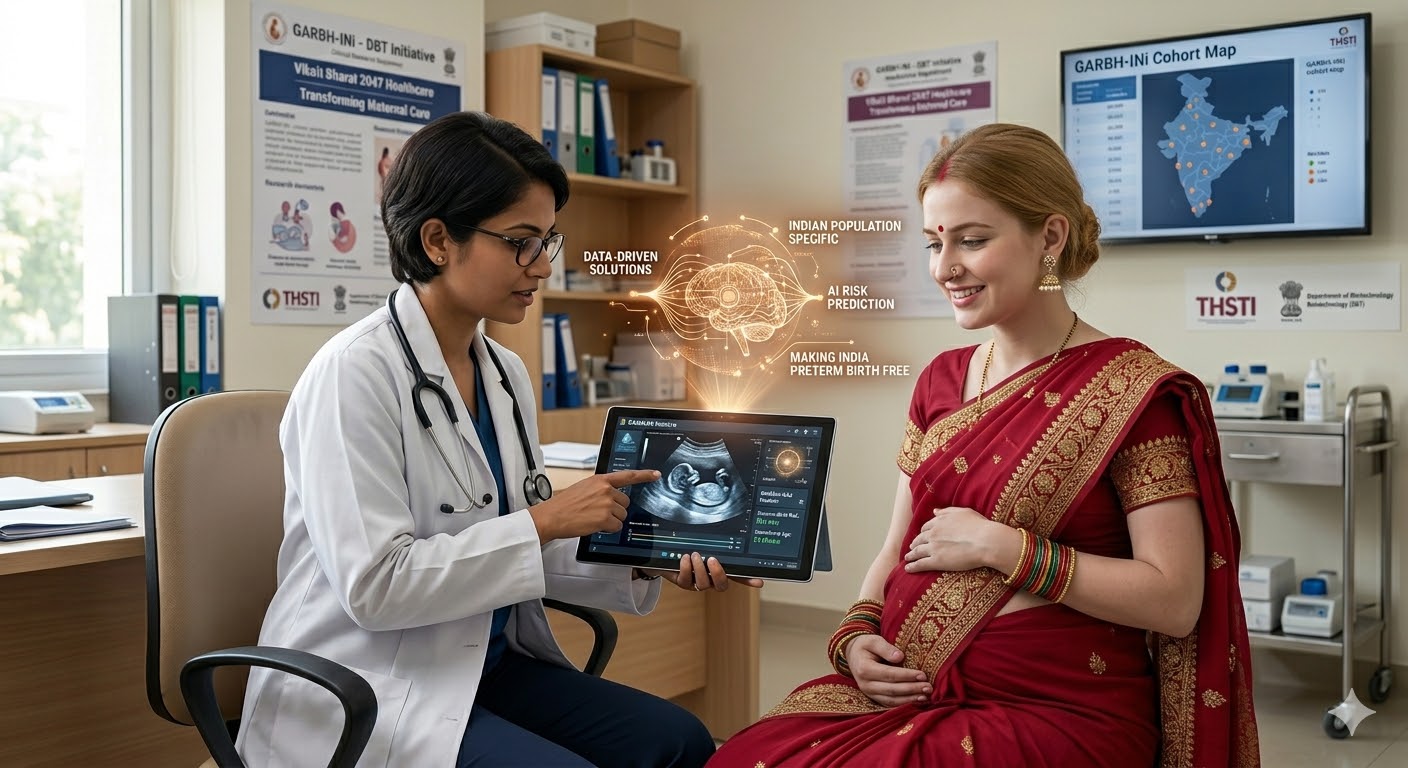
For decades, Indian doctors have relied on “Western” ultrasound data to calculate due dates—a mismatch that often leads to missed risks and inaccurate medical advice for Indian mothers.
That gap is finally closing. In a historic milestone for maternal healthcare, the Department of Biotechnology (DBT) has unveiled the results of GARBH-INi, the nation’s largest-ever pregnancy study. By tracking 12,000 women and harnessing the power of Artificial Intelligence (AI), Indian scientists have developed a first-of-its-kind “Made in India” model to predict and prevent preterm births.
Whether you are an expectant parent, a medical professional, or a tech enthusiast, the GARBH-INi initiative represents a massive leap toward a healthier “Viksit Bharat 2047.” Here is how this AI-driven mission is saving lives.
What is the GARBH-INi Initiative?
GARBH-INi is a flagship programme under the Ministry of Science & Technology. It isn’t just a study; it is a high-tech mission to build indigenous solutions for Indian mothers.
Unlike older medical tools based on Western data, GARBH-INi uses data specifically from Indian populations to predict birth risks. The initiative integrates four major scientific pillars:
- Clinical Epidemiology: Tracking health patterns in real-world settings.
- Multi-omics Biomarkers: Analyzing biological markers at a molecular level.
- Artificial Intelligence (AI): Using machine learning to identify high-risk pregnancies early.
- Genomics & Microbiome Research: Studying how genetics and gut health influence birth timing.
Why This Matters: The Preterm Birth Crisis
Preterm birth (birth before 37 weeks) is a leading cause of neonatal mortality in India. It often leads to long-term health complications and high medical costs.
Our Take: For years, Indian doctors relied on “Western” ultrasound models that often miscalculated due dates for Indian women. GARBH-INi fixes this by creating the first-ever Indian-specific pregnancy dating model.
5 Major Milestones of the GARBH-INi Programme
The recent outcomes event held on March 23, 2026, highlighted incredible progress:
- Massive Data Repository: The team collected over 1.6 million biospecimens and 1 million ultrasound images.
- AI Dating Models: Developed indigenous AI tools that provide more accurate gestational age for Indian women.
- GARBH-INi-DRISHTI: A new data-sharing platform that allows global researchers to access India’s pregnancy datasets.
- Technology Transfers: AI ultrasound reporting technology has been transferred to private partners like Qure.ai and DOTO Health.
- Microbiome Predictors: Identified specific bacterial markers that can signal a risk of preterm labor months in advance.
Strategic Partnerships for “Viksit Bharat 2047”
Union Minister Dr. Jitendra Singh emphasized that these scientific tools are vital for India’s “Viksit Bharat 2047” vision. A healthy nation starts with healthy births. The programme has already formalised partnerships:
Official PIB Release on GARBH-INi.
- SundyotaNumandis: Working on microbiome-based biotherapeutics.
- GARBH-INi-AnandiMaa: A sub-initiative focusing on risk stratification for at-risk mothers using AI-enabled reporting.
| Feature | Traditional Models | GARBH-INi AI Models |
| Data Source | Western/European Populations | Indian Population Specific |
| Accuracy | Lower for Indian physiology | High Precision for Indian mothers |
| Risk Prediction | Often reactive | Proactive (Early identification) |
| Technology | Manual Observation | AI-Enabled Ultrasound |
Garbhini-GA2 vs. Traditional Models: Why Local Data Wins
For years, the “Hadlock” and “INTERGROWTH-21st” models—developed using Caucasian and mixed global populations—were the gold standard. However, Indian babies often have different growth trajectories, leading to significant dating errors in the late second and third trimesters.
| Feature | Hadlock Formula (Western) | Garbhini-GA2 (Indian-Specific) |
| Data Source | Small Caucasian Population | 12,000+ Indian Pregnant Women |
| Estimation Error | High (overestimates PTB by ~58%) | 3x Lower Median Error |
| Algorithm | Manual Biometry | AI-Driven Genetic Algorithm |
| Best Use Case | Western populations | Accurate for South Asian physiology |
| Primary Benefit | Standard pre-set in machines | Reduces misclassification of Preterm Birth |
Frequently Asked Questions (FAQ)
Q1. Who launched the GARBH-INi initiative?
It is a Department of Biotechnology (DBT) initiative under the Ministry of Science & Technology, Government of India.
Q2. How does AI help in preventing preterm births?
AI analyzes thousands of ultrasound images and biomarkers to find subtle patterns that human doctors might miss, allowing for early medical intervention.
Q3. What is the GARBH-INi-DRISHTI platform?
It is a national data-sharing platform that provides researchers access to South Asia’s largest pregnancy dataset to encourage further innovation.
Conclusion: A National Investment
GARBH-INi represents the pinnacle of “Made in India” science. By combining biotechnology with AI, India is not just following global trends but leading them. For expectant mothers across the country, this means safer pregnancies and a healthier start for the next generation.
The development of the Garbhini-GA2 model, validated by institutions like IIT Madras and THSTI Faridabad, marks a shift from reactive to proactive maternal care. As these tools move from labs to clinics via partners like Qure.ai, the ‘Hadlock Gap’ that once plagued Indian obstetrics is finally closing.
Comments are closed.