
EV Ecosystem in India 2026: Complete UPSC Current Affairs Notes
Ministry: Heavy Industries | Date: 17 March 2026 | Source: PIB Delhi (Release IDs: 2241269, 2241264, 2241265)
Introduction
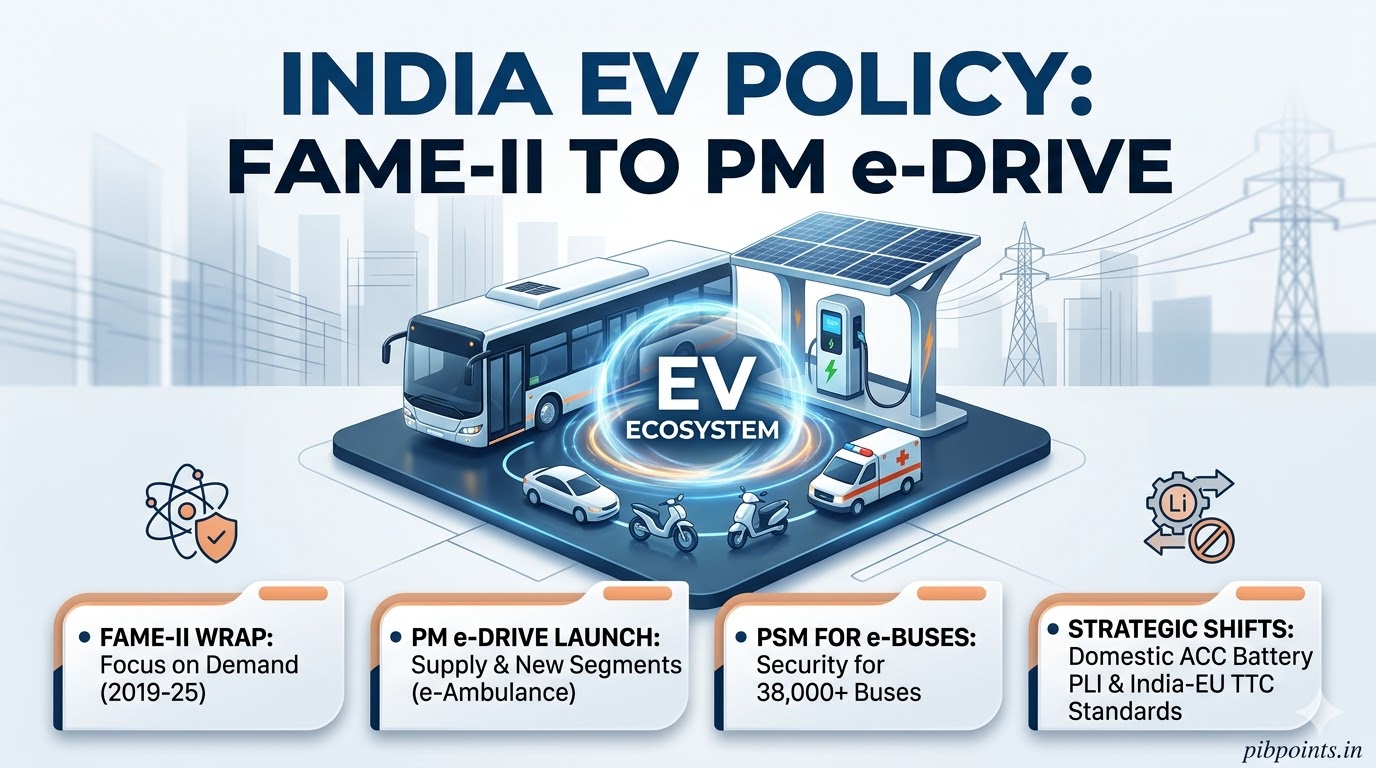
Six PIB releases on 17 March 2026 from the Ministry of Heavy Industries provide a comprehensive update on India’s Electric Vehicle (EV) ecosystem. Covering FAME-II, PM e-Drive, PM e-Bus Sewa (PSM), the impact of China’s lithium policy on EVs, and EV charging standards under the India-EU TTC, this is one of the most important current affairs clusters for UPSC Prelims 2026, Mains GS-III, and all green economy aspirants.
Part 1: FAME-II Scheme
| Scheme Name | FAME India Phase II (Faster Adoption and Manufacturing of EVs) |
| Period | 2019–20 to 2024–25 |
| Total Outlay | ₹11,500 crore |
| Ministry | Heavy Industries |
| Target | Support 10 lakh 2-wheelers, 5 lakh 3-wheelers, 55,000 4-wheelers, 7,090 e-buses |
| Charging Infra | 2,877 charging stations sanctioned |
FAME-II Key Objectives
- Promote EV adoption through demand incentives (subsidies to buyers)
- Develop public charging infrastructure across cities and highways
- Support domestic EV manufacturing ecosystem
- Reduce vehicular pollution and fuel import dependency
Part 2: PM e-Drive Scheme
| Scheme Name | PM Electric Drive Revolution in Innovative Vehicle Enhancement (PM e-DRIVE) |
| Outlay | ₹10,900 crore |
| Period | 2024–25 to 2026–27 (2 years) |
| Ministry | Heavy Industries |
| Key Focus | e-2 wheelers, e-3 wheelers, e-ambulances, e-trucks, charging infra |
PM e-Drive vs FAME-II
| Parameter | FAME-II | PM e-Drive |
|---|---|---|
| Period | 2019–25 | 2024–27 |
| Outlay | ₹11,500 Cr | ₹10,900 Cr |
| Focus | Demand subsidy | Supply + demand + charging |
| New segments | Standard EVs | e-ambulance, e-truck added |
Part 3: PM e-Bus Sewa – Payment Security Mechanism (PSM)
The PM e-Bus Sewa PSM Scheme provides payment security to operators of electric buses deployed under public bus transport systems. It ensures that OEMs (bus manufacturers) and operators receive guaranteed payments even when State Transport Undertakings (STUs) face revenue shortfalls.
- Guarantees payments to e-bus operators/OEMs
- Enables risk-free private investment in public e-bus fleets
- Covers cities with populations above 3 lakhs
- Targets deployment of 38,000+ electric buses under PM e-Bus Sewa
Part 4: Impact of China’s Lithium Policy on India’s EV Sector
China’s export restrictions on lithium processing technologies (as part of its critical minerals strategy) have created supply chain concerns for India’s EV battery manufacturing. Key points:
- India is heavily dependent on China for lithium-ion battery imports
- This creates strategic vulnerability for India’s EV transition
- Government response: Promote domestic battery manufacturing through PLI (Production Linked Incentive) scheme for ACC (Advanced Chemistry Cell) batteries
- India is exploring lithium deposits in Rajasthan, Jammu & Kashmir, and Chhattisgarh
- Strategic alliances with Australia, Argentina, and Chile for lithium sourcing
Part 5: India-EU EV Charging Technology Cooperation
Under the India-EU Trade and Technology Council (TTC), a 2nd workshop on EV charging technologies was held covering standardisation, smart and bidirectional charging, megawatt charging systems, and wireless charging — aligning India’s charging standards with global best practices.
Quick Revision Box
- FAME-II Outlay: ₹11,500 crore | Period: 2019–25
- PM e-Drive Outlay: ₹10,900 crore | Period: 2024–27
- PM e-Bus Sewa target: 38,000+ e-buses
- EV charging standards: India-EU TTC cooperation
- Lithium risk: China export restrictions → Push for domestic ACC battery PLI
- Ministry: Heavy Industries
Source: PIB Delhi, 17 March 2026 | Release IDs: 2241269, 2241264, 2241265, 2241267, 2241262, 2241477
Also Read: Related UPSC Notes on Science & Technology
- Indian Cyber Coordination Centre (I4C) – UPSC Notes
- AI-Based Monsoon Forecasting for Kharif Farming – UPSC Notes
Comments are closed.