
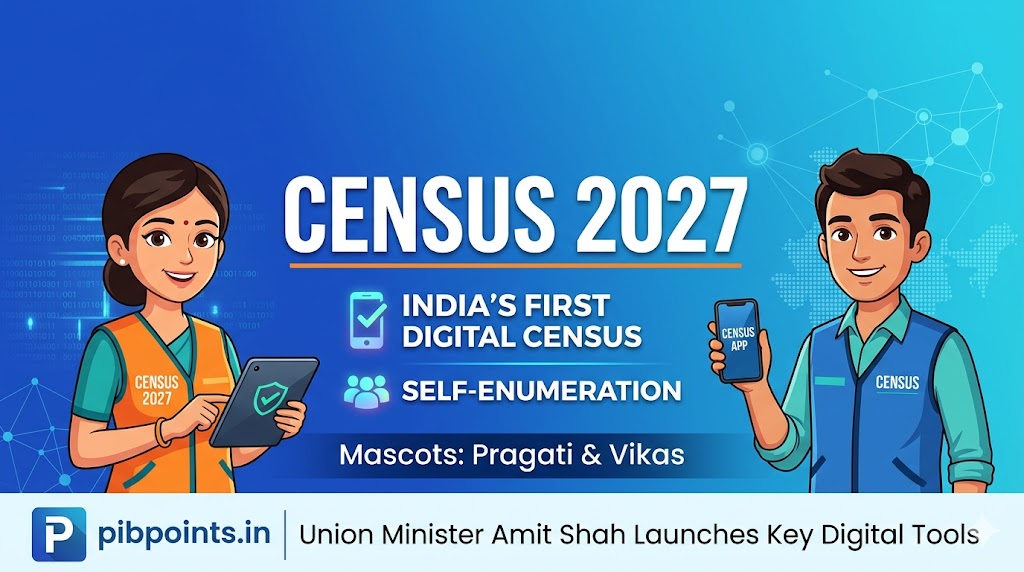
The unveiling of the official Mascots Pragati and Vikas marks a historic milestone in India’s journey toward the World’s Largest Census-2027. Launched by Union Minister of Home Affairs and Cooperation, Amit Shah, these symbols represent a modern, digital-first approach to data collection. This initiative is a core part of the national resolve to transform India into a Viksit Bharat by 2047, ensuring that every citizen’s voice is counted through innovative digital tools.
The Face of Census 2027: Pragati and Vikas
To make this massive exercise more relatable, the government has introduced two official mascots:
- Pragati (Female Enumerator)
- Vikas (Male Enumerator)
These mascots are designed to be friendly and approachable symbols. More importantly, they represent the equal participation of men and women in the national journey toward becoming a developed nation. They will be the primary faces used in public outreach campaigns to spread awareness about the census objectives.
Key Highlights: What’s New?
For the first time in history, the Indian Census is moving away from traditional paper-based methods to a fully integrated digital ecosystem.
| Feature | Description |
| First Digital Census | Data will be collected using secure mobile applications, replacing the 150-year-old paper system. |
| Self-Enumeration | A secure web-based portal allows citizens to fill out their own household details in 16 languages. |
| Real-Time Monitoring | An integrated dashboard (CMMS) allows officials to track field performance and progress in real-time. |
| Caste Enumeration | For the first time, the second phase will also include a caste-related question. |
The Road to Census 2027: Key Phases and Deadlines
Following the unveiling by Union Minister Amit Shah, the Census 2027 is set to be a landmark event in India’s administrative history. To help you stay ahead, here is the detailed breakdown of the timeline and the state-wise implementation strategy.
Phase 1: House-listing & Housing Census
Timeline: April 1, 2026 – September 30, 2026
During this six-month window, enumerators will visit every household to collect data on housing characteristics and basic amenities. However, before the door-to-door survey begins in a specific region, residents can use the Self-Enumeration portal.
Self-Enumeration Windows (Tentative Schedule)
The self-enumeration option will be open for 15 days in each state/UT prior to the start of the physical survey.
| Region Group | Expected Self-Enumeration Window |
| Group A: Southern & Western States (e.g., TN, Kerala, MH, Gujarat) | April 2026 |
| Group B: Central & Northern States (e.g., MP, UP, Rajasthan, Haryana) | May – June 2026 |
| Group C: Eastern & North-Eastern States (e.g., WB, Bihar, Odisha, Assam) | July – August 2026 |
| Group D: Union Territories & Special Zones | September 2026 |
Phase 2: Population Enumeration
Timeline: February 2027
This is the “main event” where detailed demographic data is captured.
- National Count: Conducted throughout February 2027, with a revision round in the first week of March 2027 to account for births and deaths occurring until the reference date (March 1).
- Snow-bound Areas Exception: In regions like Ladakh, parts of Himachal Pradesh, and Uttarakhand, the enumeration will be advanced to September 2026 to avoid the harsh winter months when these areas become inaccessible.
Critical Deadlines for Administrative Prep
To ensure the digital census runs smoothly, several administrative “freezes” are put in place:
- Freezing of Boundaries: All state and district administrative boundaries were frozen as of January 1, 2026, to ensure no data overlap.
- Portal Access: The Self-Enumeration portal is expected to go live in stages starting April 2026.
Why the Phases Matter
By splitting the process, the government ensures that:
- Phase 1 acts as the frame for the entire country, identifying every single household.
- Phase 2 provides the deep-dive statistics that will drive policy for the next decade.
Note for Aspirants: Remember that the 2011 Census used a 2001-2011 base, but Census 2027 is the first to utilize a fully digital verification system, drastically reducing the “data-to-release” lag.
Source: Detailed updates and official notifications can be monitored via the Press Information Bureau.
A “Quick Bite” for Revision
- Launched by: Union Minister Amit Shah.
- Mascots: Pragati and Vikas.
- Tech Partner: Developed by the Centre for Development of Advanced Computing (C-DAC).
- The “Firsts”: 100% Digital, Self-Enumeration option, and Caste Enumeration.
- Source: For the official press release, refer to the Ministry of Home Affairs via PIB Release ID: 2235470.
FAQ Section (Schema Ready)
Q1: What is the benefit of the Self-Enumeration portal?
It allows residents to submit their household data online at their convenience. After submission, a unique Self-Enumeration ID (SE ID) is generated, which you simply share with the enumerator when they visit for verification.
Q2: Is the digital census secure?
Yes, data is collected through secure mobile applications developed by C-DAC. Individual data remains confidential and cannot be used as evidence in court or for determining eligibility for specific government schemes.
Q3: Why was there no census in 2021?
The 2021 decennial census was delayed primarily due to the COVID-19 pandemic, which restricted field activities and door-to-door data collection.