
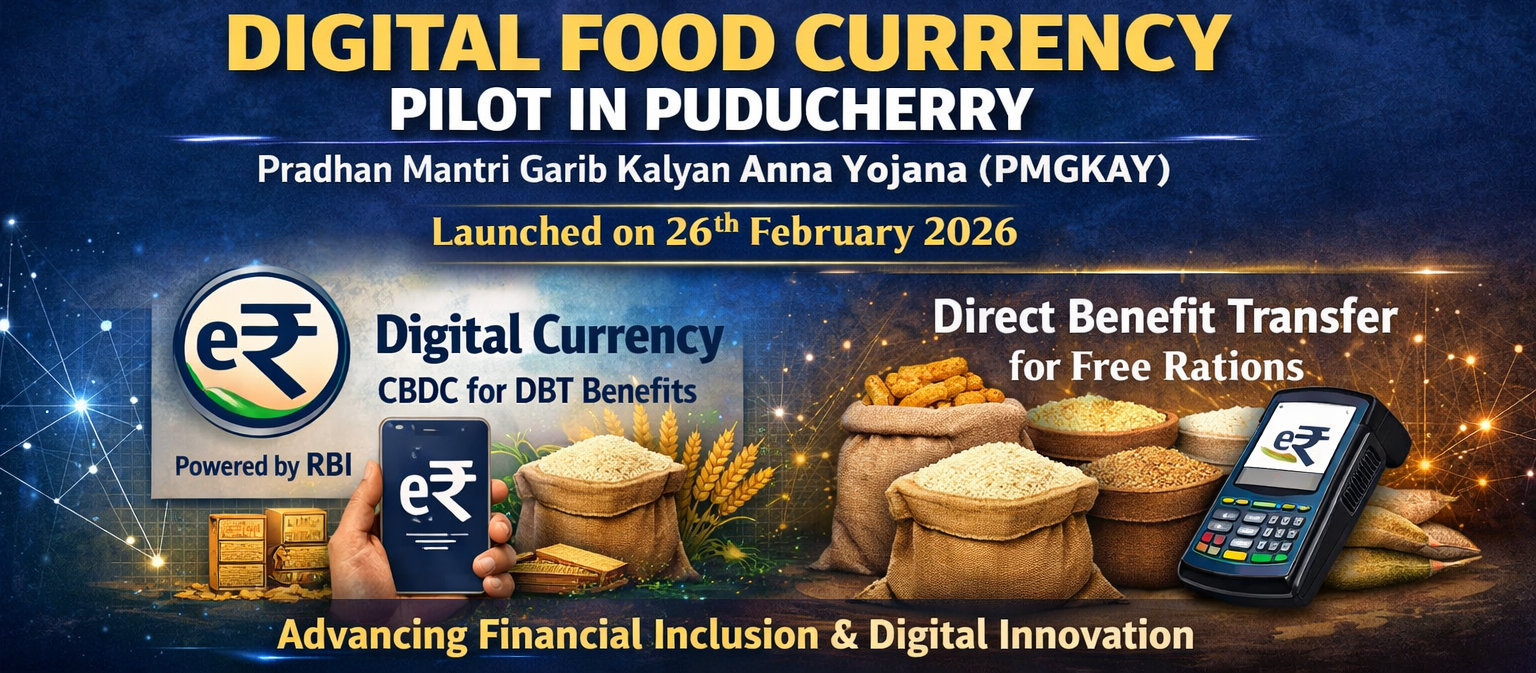
Government of India has launched a Central Bank Digital Currency (CBDC)-based Digital Food Currency pilot for Direct Benefit Transfer (DBT) under Pradhan Mantri Garib Kalyan Anna Yojana (PMGKAY) in Puducherry. The pilot was inaugurated on 26th February 2026 by Union Minister for Consumer Affairs, Food and Public Distribution, Shri Pralhad Joshi, in the presence of the Lieutenant Governor and Chief Minister of Puducherry.
India’s Central Bank Digital Currency (CBDC), known as the e-Rupee or e₹, represents a pivotal shift in the nation’s monetary landscape, blending innovation with financial inclusion. Launched by the Reserve Bank of India (RBI), it builds on successes like UPI while addressing modern challenges in payments and welfare delivery.
Global Origins of CBDC
Central Bank Digital Currencies emerged post-2009 with Bitcoin’s rise, prompting governments to explore sovereign digital alternatives to counter private cryptocurrencies’ risks. By 2023, India led PwC’s global CBDC index through active retail and wholesale pilots, outpacing many peers except live implementations like China’s e-CNY. Today, over 100 countries pursue CBDCs, focusing on efficiency, inclusion, and cross-border settlements.
India’s CBDC History Timeline
The journey began in January 2017 when an inter-ministerial committee recommended a DLT-based sovereign digital currency. RBI formed working groups, and by 2020, regulatory sandboxes tested technologies; the 2021 Currency and Finance Report outlined non-anonymous, inclusion-focused designs.
Key milestones include:
- October 2022: RBI announces pilots.
- November 1, 2022: Wholesale CBDC pilot starts with nine banks.
- December 1, 2022: Retail e₹ pilot launches, achieving 1 million daily transactions by end-2023.
- 2025: Offline functionality introduced at Global Fintech Fest; 8 million users by December.
- February 15, 2026: Union Minister Amit Shah launches first full CBDC program.
- February 26, 2026: CBDC pilot for PMGKAY DBT in Puducherry.
Amendments to the RBI Act in 2022 empowered issuance, with phased nationwide rollout planned.
Support PibPoints.in with RBI Digital Rupee (e₹)
If you find our news analysis useful, you can support our independent work by sending a small contribution in RBI’s official Digital Rupee (e₹). Just scan the QR code below using your bank’s digital rupee wallet app and pay any amount of your choice.
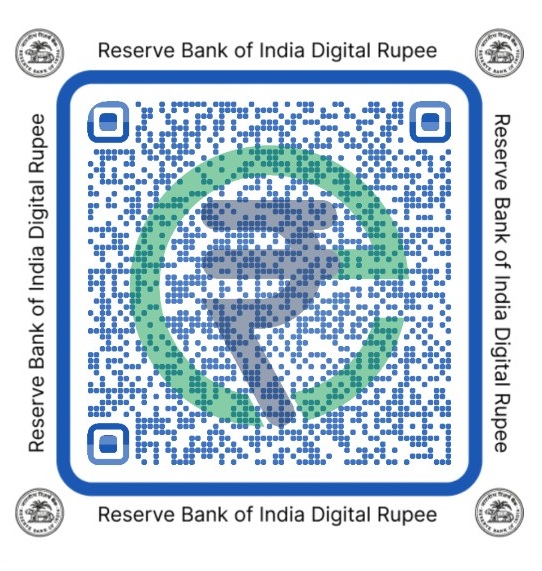
How to pay:
- Open your participating bank’s Digital Rupee / e₹ wallet app. [web:11][web:16]
- Choose the option to “Scan & Pay”.
- Scan this QR code, enter the amount you wish to contribute, and confirm.
Your support helps us keep PIB-based, fact‑checked information free and accessible for everyone. Thank you for backing quality public‑interest journalism.
Technical Design and Features
e₹ operates in token-based (cash-like for retail) or account-based (for wholesale) models, using a two-tier system: RBI issues to banks for distribution. It supports P2P, P2M, offline transactions, and programmability for targeted uses like DBT.
| Feature | Retail CBDC (e₹-R) | Wholesale CBDC (e₹-W) |
|---|---|---|
| Users | Individuals, merchants | Banks, institutions |
| Purpose | Everyday payments, inclusion | Interbank settlements |
| Tech | Offline-enabled, programmable | DLT for efficiency |
| Wallets | App-based via banks | Institutional platforms |
No interest is earned on holdings, but conversion to deposits is seamless. By FY2024-25, transactions hit USD 113 million.
Experience India’s New Digital Rupee with Canara Bank
Open your Canara Digital Rupee wallet, load and redeem e₹, send and receive tokens, and scan any merchant UPI QR to pay instantly and securely.
Download the “Canara Digital Rupee” app now on Google Play and the App Store.
Get it on Google Play Download on App StoreRecent CBDC Pilot in Food Security
On February 26, 2026, Union Minister Pralhad Joshi inaugurated a CBDC-based Digital Food Currency pilot in Puducherry for PMGKAY DBT, crediting programmable e₹ tokens directly to beneficiaries’ wallets. These tokens redeem exclusively for foodgrains at Fair Price Shops, bypassing biometric/e-POS issues and curbing leakages.
This integrates with PDS digitization (ONORC, e-POS), empowering 80 crore beneficiaries with real-time, traceable entitlements. Expansion to Chandigarh, Dadra & Nagar Haveli, and more states follows analysis. Joshi hailed it as a “milestone reform” under “Every grain, Every rupee, Every entitlement.”
Benefits, Challenges, and Future
CBDC boosts inclusion (reaching non-internet users via offline modes), cuts costs, and enables purpose-bound transfers like subsidies. Challenges include connectivity gaps (affecting 57.5 crore Indians) and privacy concerns.
India eyes cross-border uses and full rollout by 2027, positioning e₹ as a global leader. For Puducherry residents, this pilot exemplifies Digital India’s welfare evolution.
[…] personal finance planning, home loans, education goals and retirement strategy. Our explainer on India’s CBDC-based Digital Food Currency Pilot shows how digital payments and welfare reforms are converging with salary and pension delivery […]
[…] Explore More: Interested in how India is digitizing its economy? Read our deep dive on CBDC and the Future of Digital Food Currency. […]