
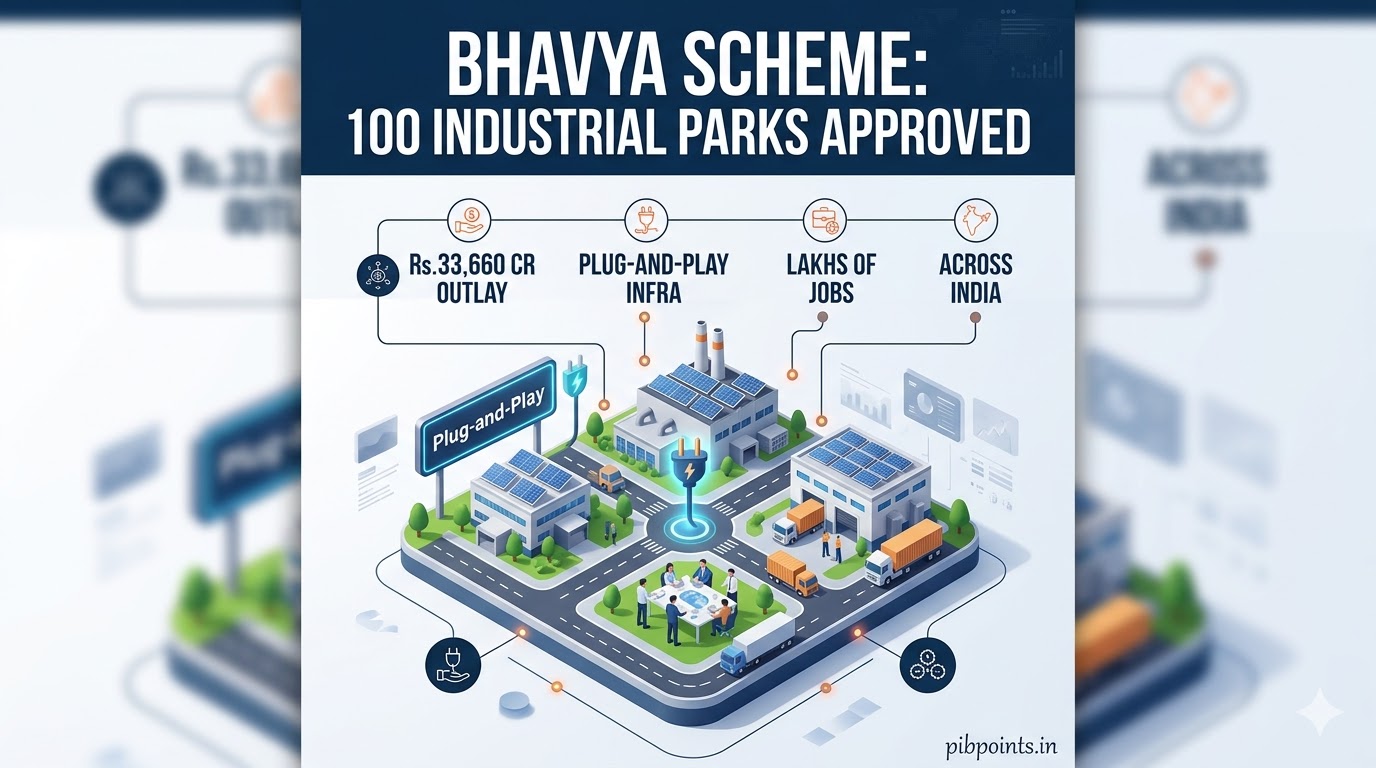
The Government of India has officially approved the BHAVYA Scheme (Bharat Audyogik Vikas Yojna) with a massive outlay of ₹33,660 crore. Aimed at revolutionizing the MSME sector, this central sector scheme will develop 100 “Plug-and-Play” Industrial Parks between FY 2026-27 and 2031-32.
What is the BHAVYA Scheme?
BHAVYA stands for Bharat Audyogik Vikas Yojna. It is designed to provide “ready-to-use” infrastructure, allowing industries to move from intent to production without delays in land acquisition or utility setup.
The National Industrial Corridor Development Corporation (NICDC) under the DPIIT (Ministry of Commerce) will anchor the implementation, building on its success with 20 existing projects across 13 states.
NICDC is scaling this model based on the success of existing industrial smart cities like Dholera (Gujarat), Shendra-Bidkin (Maharashtra), and Vikram Udyogpuri (MP).
Key Features and Financial Support
- Total Outlay: ₹33,660 Crore.
- Target: 100 Industrial Parks (50 to be developed in the First Phase).
- Scale: 100 to 1,000 acres (Relaxed to 25 acres for North Eastern and Hilly states).
- Funding for Internal Infra: Up to ₹1 Crore per acre for “No-Dig” underground utilities, ICT, and roads.
- External Connectivity: Support for up to 25% of project cost for last-mile rail/road links.
The 3 Pillars of BHAVYA Infrastructure
To ensure these parks are world-class, the government has categorized support into three distinct pillars:
- Core Infrastructure: Internal roads, integrated underground utility corridors (water, power, fiber), and common effluent treatment plants.
- Value-Added Infrastructure: Ready-built factory sheds, testing laboratories, and specialized warehousing.
- Social Infrastructure: Integrated worker housing, health centers, and support amenities to ensure a stable and productive workforce.
Comparison: BHAVYA Scheme vs. NICDP (Industrial Smart Cities)
While both initiatives fall under the National Industrial Corridor Development Programme (NICDP), they serve very different purposes in India’s industrial ecosystem.
| Feature | NICDP (Large Scale) | BHAVYA Scheme |
| Primary Target | Large Scale Anchor Industries | MSMEs and Startups |
| Scale | Massively large (City-sized) | Boutique (100–1000 Acres) |
| Infrastructure | Long-term development | Immediate “Plug-and-Play” |
| Flexibility | Fixed Locations | Dispersed across 100 locations |
Challenge Mode: How States are Selected
Selection isn’t random. States must compete in a “Challenge Mode” based on:
- PM GatiShakti Alignment: Multi-modal connectivity readiness.
- Ease of Doing Business: Active Single-Window systems and deregulation.
- Sustainability: Commitment to green energy and zero-liquid discharge.
Comparison: BHAVYA vs. PM MITRA
| Feature | BHAVYA Scheme | PM MITRA Scheme |
| Focus | Sector-Agnostic (All Manufacturing/MSMEs) | Specifically for the Textile Sector |
| Outlay | ₹33,660 Crore | ₹4,445 Crore |
| Pillars | Plug-and-Play for all 100 locations | 5F Vision (Farm to Foreign) |
| Developer | NICDC (under DPIIT) | Ministry of Textiles |
“Quick Bite” for Fast Revision
The “No-Dig” Advantage: > BHAVYA parks feature integrated underground corridors. All maintenance happens within these tunnels, ensuring that industrial operations are never interrupted by road-digging for repairs.
Selection Criteria: The Challenge Mode Explained
Unlike traditional industrial schemes, the BHAVYA Scheme utilizes a competitive “Challenge Mode” to select the 100 park locations. This ensures that only the most prepared states receive central funding.
- Unencumbered Land: To qualify, states must provide unencumbered land—meaning the land must be 100% free from legal disputes, litigation, or existing encumbrances.
- Minimum Land Size: * General States: A minimum of 100 acres is required.
- Hilly & North Eastern States: The threshold is relaxed to 25 acres to ensure regional inclusivity.
- Connectivity Readiness: States must demonstrate proximity to PM GatiShakti nodes (highways, rail sidings, or ports).
FAQs for BHAVYA Scheme
Q1: What is the duration of the BHAVYA scheme?
The scheme will run for 6 years, from FY 2026-27 to 2031-32.
Q2: Can a private player partner in this scheme?
Yes, it is implemented in partnership with State Governments and Private Sector players.
Q3: How many jobs will this create?
The government estimates the creation of approximately 15 lakh direct jobs.
Q4. What is the maximum size for a BHAVYA industrial park?
The parks range from 100 to 1,000 acres, with a relaxed limit of 25 acres for Hilly and North Eastern states.
Source: For the official press release and deep-dive data, refer to the Ministry of Commerce & Industry via PIB Release ID: 2241785.
Comments are closed.