
Ministry: Agriculture & Farmers Welfare | Date: 17 March 2026 | Source: PIB Delhi (Release ID: 2241412)
Introduction
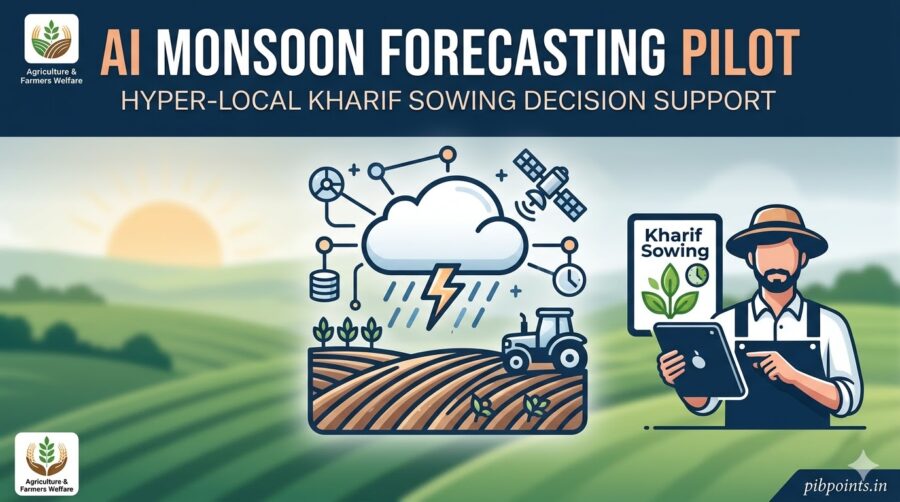
The Ministry of Agriculture & Farmers Welfare recently greenlit a transformative AI-based pilot for local monsoon forecasting, specifically designed to de-risk the volatile Kharif sowing season. This isn’t just another weather app; it represents a fundamental shift in India’s Digital Public Infrastructure (DPI). By moving away from broad regional forecasts toward hyper-local, village-level intelligence, the government is providing a “digital shield” for over 3.8 crore farmers.
For UPSC aspirants and policy analysts, this pilot (PIB Release ID: 2241412) serves as a case study in Precision Agriculture, showcasing how Google’s NeuralGCM and European AIFS models are being localized to solve Indian “Last Mile” connectivity challenges.
What is AI-Based Monsoon Forecasting?
AI-based monsoon forecasting is a precision agriculture technology that uses machine learning algorithms to analyze satellite data, soil moisture, and historical IMD records. Unlike traditional regional models, it provides hyper-local (village-level) weather predictions, enabling farmers to make data-driven decisions on Kharif sowing, irrigation, and crop selection to mitigate climate risks.
Traditional weather forecasting provides regional-level monsoon predictions. The new AI-based system generates local/district-level micro-forecasts by analysing satellite data, historical weather patterns, soil moisture levels, and atmospheric variables using machine learning algorithms — giving farmers precise, actionable guidance at the village or block level.
Key Features of the AI Pilot
| Technology Used | Artificial Intelligence + Machine Learning |
| Data Sources | Satellite data, IMD records, soil moisture, crop calendars |
| Forecast Level | Hyper-local (district/block level) |
| Application | Kharif sowing decision support for farmers |
| Ministry | Agriculture & Farmers Welfare |
| Partner Agencies | IMD (Indian Meteorological Department), ICAR |
How Does It Help Farmers?
- Sowing Timing: Helps farmers decide the optimal date to sow Kharif crops like paddy, maize, soybean, and cotton based on predicted rainfall patterns.
- Crop Selection: Guides farmers on which crops are best suited for the anticipated local rainfall — reducing risk of crop failure.
- Input Optimisation: Enables efficient use of fertilisers, pesticides, and irrigation based on expected weather.
- Risk Mitigation: Early warning of monsoon delays or excess rainfall helps farmers take precautionary action.
- Financial Security: Better planning reduces crop loss and reduces need for distress borrowing.
🧠 The Significance: Beyond the Technology
While the technology is impressive, the real value lies in the Socio-Economic Impact. Here is why this 2026 pilot is a “Game Changer” for the Indian economy:
1. Transition to “Predict-and-Prevent” Farming
Historically, Indian agriculture has been a “gamble on the monsoons.” Traditional IMD models offered a bird’s-eye view, often missing the micro-climates of specific districts. The 2026 AI pilot uses 300m resolution tools (meteoGAN), allowing a farmer in a specific block of Bihar to know exactly when the “monsoon onset” will hit their field. This precision prevents the “false start” sowing that leads to massive seed and fertilizer waste.
2. Strengthening the “Agri Stack” Ecosystem
This pilot acts as the “intelligence layer” for the Digital Agriculture Mission. By integrating with AgriStack (Digital Farmer IDs), the government can push personalized, multilingual voice alerts via the Bharat-VISTAAR portal. It creates a closed-loop system where:
- Data (IMD/Satellite) feeds the AI Model.
- AI Model creates the Custom Advisory.
- AgriStack identifies the Exact Farmer.
- Bharat-VISTAAR delivers the Voice Alert.
3. Macro-Economic Inflation Control
Food inflation in India is often tied to Kharif shocks. When the monsoon “breaks” unexpectedly, crop yields drop, and prices of pulses and paddy spike. By enabling 31% to 52% of farmers to change their sowing dates (as seen in the Bihar/MP trials), the government is effectively stabilizing the national food supply chain, protecting the GDP from climate-induced volatility.
Connection with Other Agriculture Initiatives
| Initiative | Connection with AI Forecasting |
|---|---|
| Digital Agriculture Mission | AI forecasting is a key component |
| Agri Stack | Farmer database enables personalised advisories |
| PM-KISAN | Beneficiary farmers can receive customised crop advisories |
| PMFBY (Crop Insurance) | AI weather data improves insurance claim accuracy |
| e-NAM | Market readiness aligned with harvest forecast |
Deep Dive: The 2026 AI Agriculture Revolution
1. Technical Edge: The Blended AI Model
Unlike previous years where India relied on physical models, the 2026 pilot uses a Blended Modelling Approach. This combines:
- NeuralGCM: Google’s open-source model that blends traditional physics with Machine Learning.
- ECMWF’s AIFS: The European Centre’s Artificial Intelligence Forecasting System.
- Historical Depth: Integration of 125 years of IMD rainfall data to “teach” the AI local nuances.
Impact: In the 2025 pilot phase across 13 states, nearly 3.88 crore farmers received these forecasts. Post-pilot surveys in Bihar and Madhya Pradesh showed that 31–52% of farmers proactively changed their sowing dates or crop choices based on this AI data.
2. Strategic Comparison: A Three-Pronged Digital Shield
To understand the 2026 pilot, you must distinguish how it fits into India’s existing tech infrastructure. This is not a standalone project but a coordinated “Digital Public Infrastructure” (DPI) effort.
| Initiative | Core Focus | Comparison to 2026 AI Weather Pilot |
| Mission Mausam | National weather safety (MoES). | Provides the High-Performance Computing (HPC) backbone (Arka & Arunika) to process the AI models used in this pilot. |
| Bharat-VISTAAR | Union Budget 2026-27 Initiative (₹150 Cr). | The multilingual, voice-first “delivery layer.” The AI weather forecasts are the content that the Bharat-VISTAAR chatbot (“Bharati”) delivers to farmers in regional dialects. |
| Agri Stack | Digital Identity (Farmer ID). | Provides the target data, ensuring the forecast reaches the exact farmer at the exact GPS coordinates of their field. |
Implications for India’s Economy & Food Security
Macro-Economic Stability (The “GDP Shock Absorber”)
Agriculture contributes approximately 18-19% to India’s GVA, but its volatility often triggers inflation.
- Inflation Control: By preventing mass crop failure during a “break” in the monsoon, the AI pilot helps stabilize prices of staples like paddy and pulses.
- GDP Protection: Industry experts estimate that AI-stabilized agriculture could contribute a 1.2–1.7% increase in annual GDP by reducing climate-induced losses.
Food Security & Precision Farming
The transition from “Regional” to “Hyper-local” (300m resolution via tools like meteoGAN) means India is moving toward Precision Agriculture.
- Reduced Input Waste: Farmers only apply fertilizers when the AI confirms no immediate heavy rainfall, preventing runoff and financial waste.
- Climate Resilience: As climate change makes the monsoon more erratic, this AI pilot serves as a “Digital Insurance” policy for the nation’s food reserves.
Quick Revision Box
- Initiative: AI-Based Pilot for Local Monsoon Forecasting
- Purpose: Support Kharif sowing decisions
- Technology: AI + ML + Satellite data
- Ministry: Agriculture & Farmers Welfare
- Partners: IMD, ICAR
- Broader framework: Digital Agriculture Mission, Agri Stack
- Benefit: Hyper-local forecasting at district/block level
Frequently Asked Questions (FAQs)
Q1: What is the AI-based pilot for monsoon forecasting launched in 2026?
Answer: It is a precision agriculture initiative by the Ministry of Agriculture & Farmers Welfare to provide hyper-local (district/block level) monsoon onset predictions. Launched via PIB Release ID 2241412, the pilot uses a blended AI model to help farmers time their Kharif sowing (paddy, maize, soybean) with up to a 30-day lead time.
Q2: Which AI models are used in India’s 2026 weather forecasting pilot?
Answer: The system utilizes an “Open-Source Blended Modelling” approach, combining:
- NeuralGCM: Google’s model that blends traditional physics with Machine Learning.
- ECMWF’s AIFS: The European Centre’s Artificial Intelligence Forecasting System.
- IMD Historical Data: 125 years of rainfall records used for bias correction and localizing results.
Q3: What is Bharat-VISTAAR mentioned in the Union Budget 2026?
Answer: Bharat-VISTAAR (Virtually Integrated System to Access Agricultural Resources) is a multilingual AI portal. It acts as the “delivery layer” for AI weather forecasts, integrating the AgriStack farmer database with ICAR agricultural practices to provide customized, voice-first advisories to farmers in their regional languages.
Q4: How does hyper-local forecasting differ from traditional IMD forecasts?
Answer: Traditional forecasts provide regional or state-level trends. The 2026 AI pilot offers village-level resolution (up to 300m via meteoGAN tools). This allows farmers to know the specific onset date for their own fields, reducing the risk of “false starts” where early rains are followed by a dry spell that kills newly sown seeds.
Q5: How many farmers have benefited from this AI weather initiative?
Answer: During the 2025-26 pilot phase, over 3.88 crore farmers across 13 Indian states received AI-driven SMS alerts. Success surveys in states like Bihar and Madhya Pradesh showed that 31% to 52% of farmers successfully changed their sowing dates or crop varieties based on these AI insights.
Q6: Is this initiative part of the Digital Agriculture Mission?
Answer: Yes. The AI pilot is a core component of the Digital Agriculture Mission (outlay of ₹2,817 Crore). It works alongside AgriStack (Digital Farmer IDs) and the Krishi Decision Support System (DSS) to build a Digital Public Infrastructure (DPI) for Indian farming.
Source: PIB Delhi, 17 March 2026 | Release ID: 2241412
Also Read: Related UPSC Notes on Agriculture
- e-NAM, FPO & Agriculture Credit Reforms 2026 – UPSC Notes
- PMMSY 2026: Complete UPSC Notes on Fisheries Scheme
Comments are closed.