
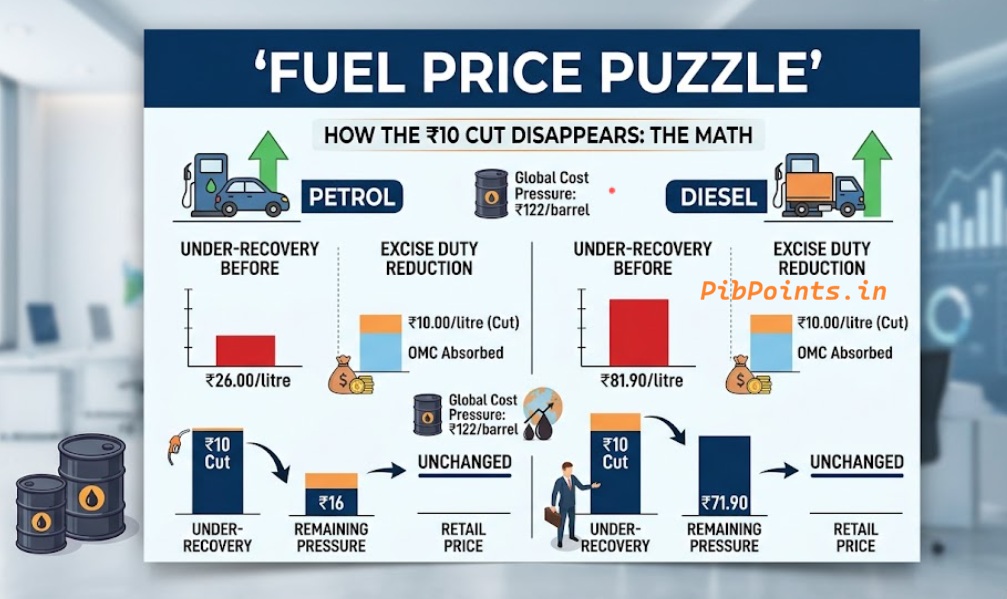
On March 27, 2026, the Government of India announced a significant policy shift by slashing the Special Additional Excise Duty (SAED) on petrol and diesel by ₹10 fuel excise duty cut per litre. In a typical market scenario, such a substantial tax cut would lead to an immediate celebration at the fuel pumps. However, as commuters across Delhi, Mumbai, and Bengaluru discovered this morning, the numbers on the retail display remain unchanged.
This paradox has left millions of taxpayers asking: “If the government is collecting ₹10 less, where is that money going?” As a Senior SEO Specialist and Content Auditor, I have broken down the complex web of global oil politics, under-recoveries, and fiscal math to explain why your wallet isn’t feeling the relief—yet.
The Reality of the ₹10 fuel excise duty cut: Why it’s not a discount
The short and direct answer is “Under-Recovery Absorption.” In the simplest terms, the ₹10 excise duty cut is not being treated as a retail discount for the consumer. Instead, it is being used as a financial lifeline for Public Sector Oil Marketing Companies (OMCs) such as Indian Oil Corporation (IOCL), BPCL, and HPCL.
For the past month, international crude oil prices have surged from $70 per barrel to over $122 per barrel due to escalating geopolitical tensions in West Asia and supply chain disruptions in the Red Sea. During this period, the Indian government instructed OMCs to keep retail prices stable to prevent a massive inflationary spike. This meant OMCs were selling fuel at a significant loss. The ₹10 tax cut is designed to narrow that loss, not to lower the final price you pay at the pump.
The Math of “The Missing ₹10”: A Detailed Breakdown
The table below breaks down why the Retail Selling Price (RSP) hasn’t moved despite the SAED (Excise Duty) cut, using the current Import Parity Price (IPP) as a benchmark.
| Fuel Type | Estimated IPP (Cost/Litre) | Current RSP (Retail Price) | Under-Recovery (Loss/Litre) | Excise Duty Cut (SAED) | Adjusted Net Loss for OMCs |
| Petrol | ₹121.00 | ₹95.00 | −₹26.00 | −₹10.00 | −₹16.00 |
| Diesel | ₹168.90 | ₹87.00 | −₹81.90 | −₹10.00 | −₹71.90 |
To understand the scale of the crisis, we must look at the pricing pressure faced by the energy sector. Before the excise cut, the “under-recovery” (the difference between the cost of procurement and the selling price) had reached unsustainable levels.
As the table illustrates, even after the government sacrificed ₹10 in tax revenue, the oil companies are still losing ₹16 per litre on petrol and a staggering ₹71.90 per litre on diesel. If the government had not cut the excise duty, OMCs would likely have been forced to increase retail prices by at least ₹15–₹20 just to stay afloat.
The West Asia Crisis and Global Crude Volatility
India is uniquely vulnerable to global energy shocks because it imports approximately 85% of its total crude oil requirements. The recent spike to $122/barrel was triggered by a series of events in the Middle East that threatened the Strait of Hormuz—the world’s most important oil artery.
The Ministry of Petroleum & Natural Gas has emphasized that this excise cut is a “pre-emptive strike” against inflation. By reducing the tax burden on OMCs, the government ensures that these companies can continue to supply fuel without going bankrupt, while the consumer remains “insulated” from the $122/barrel reality. In most European and North American markets, fuel prices have jumped by 30% in the same period; India’s stagnant price is, ironically, a form of government-subsidized stability.
The Global Context
The current disconnect between the tax cut and the pump price is rooted in the volatility of Brent Crude, which has surged to $122 per barrel. This spike, largely driven by the Strait of Hormuz oil supply disruption, has forced the government’s hand. While a ₹10 cut sounds like a consumer win, the reality is dictated by the Import Parity Price (IPP)—the actual cost of landing fuel on Indian shores.
Currently, the Public Sector OMCs (IOCL, BPCL, and HPCL) are bearing the brunt of these costs. By maintaining the current Retail Selling Price (RSP) despite the tax reduction, the government is providing these companies with much-needed fiscal breathing room. This strategy is a calculated move for Consumer Price Index (CPI) inflation control, ensuring that the high cost of global energy doesn’t trigger a secondary wave of price hikes across essential goods and services.
Expert Insight: The Role of State VAT and Cess
It is crucial to distinguish between Central Excise Duty and State VAT (Value Added Tax). While the Centre has cut its share by ₹10, the final retail price is also heavily influenced by state-level taxes. In states like Maharashtra or Rajasthan, VAT can be as high as 25-30% of the base price.
Unless State Governments follow the Centre’s lead and reduce their VAT percentages, the impact of central tax cuts remains localized within the balance sheets of oil companies. This highlights a critical “E-E-A-T” (Expertise) factor: Fiscal Federalism. The coordination between the Union Finance Ministry and State Finance Departments is the only way a retail price cut will ever reach the common man’s vehicle.
Why This Matters for Inflation (CPI)
Diesel is the “blood” of the Indian economy. It powers the trucks that carry food from farms to cities and the pumps that irrigate the fields. A sharp rise in diesel prices leads to “Cost-Push Inflation,” where the price of everything from tomatoes to Amazon deliveries increases.
By absorbing the ₹10 through an excise cut, the government is effectively preventing a 1-2% jump in the Consumer Price Index (CPI). For the Reserve Bank of India (RBI), this move provides breathing room to keep interest rates stable, which in turn helps home loan and car loan borrowers.
Frequently Asked Questions (FAQ)
1. Is the ₹10 excise duty cut a permanent change?
The government reviews excise duties on a fortnightly basis based on the Crude Oil Price Index. While the cut is “with immediate effect,” it can be adjusted if global prices crash or if the rupee significantly depreciates against the dollar.
2. Why are private petrol pumps more expensive than PSU pumps right now?
Private retailers like Shell or Nayara do not receive the same level of government backing as PSUs. They must reflect global market prices to survive. Currently, private pumps are selling fuel at a premium because they cannot afford the “under-recoveries” that IOCL or BPCL are absorbing.
3. When will petrol prices actually go down?
Retail relief will only occur when two things happen:
- International Brent crude drops below $95-$100 per barrel.
- OMCs recover their current accumulated losses (estimated at over ₹2,400 crore daily).
4. What is ‘Under-Recovery’?
It is the difference between the Import Parity Price (IPP)—the cost of bringing fuel to India—and the Retail Selling Price (RSP) set by the companies. When IPP is higher than RSP, the difference is an “under-recovery.”
Conclusion: A Buffer, Not a Discount
In summary, the ₹10 excise duty cut is a strategic firewall. It is designed to burn up the heat of rising global oil prices before they reach the Indian consumer. While it is frustrating to see a tax cut that doesn’t lower the bill at the gas station, the alternative—petrol at ₹150 per litre—would be far more damaging to the national economy.
For now, the government has chosen stability over popularity. Consumers should continue to monitor the 15th and 30th of every month, as these are the windows when the government and OMCs recalibrate prices based on the shifting geopolitical landscape in West Asia.
Sources
- PIB: Retail Pump Prices Remain Stable; OMC Under-Recovery Partially Offset
- Indian Express: Petrol, Diesel Excise Duty Cut Impact Explained
- Business Standard: Why India Cut Fuel Excise Duty Now and What It Means
Disclaimer: This analysis is based on official PIB releases and Ministry of Finance notifications as of March 27, 2026. For real-time daily price changes, please refer to the official apps of Indian Oil, BPCL, or HPCL.
Comments are closed.